
Real Estate Lead Management: From First Enquiry to Site Visit in 5 Steps
Good lead management is not a tool, it is a process. Five steps to take a real estate enquiry from the first message to a booked site visit.
Arthaleads Team · · 8 min read
Real estate leads arrive from many places at once: Facebook and Instagram ads, Google Ads, property portals, your website, walk-ins, WhatsApp messages and hoardings with a QR code. Without real estate lead management, each source becomes its own spreadsheet, the same buyer gets called three times by three people, and the buyer who was ready to visit this weekend slips through because nobody called them back.
Lead management is the process that turns that mess into one list, a clear owner for every lead and a predictable path to a site visit. It is not a piece of software. Software helps, but only once the process is clear. This guide walks through the five steps that matter most for Indian developers, brokers and channel partners, the stages a lead should move through, the numbers to watch, and the mistakes that quietly cost teams their best buyers.
Why real estate lead management matters more than lead volume
Most teams try to fix a slow month by buying more leads. More budget on Facebook, another portal package, one more expo stall. But if half of today's enquiries are never called back properly, doubling the enquiries doubles the waste.
Speed is the clearest example. In a well-known study published in the Harvard Business Review, companies that tried to contact a lead within an hour were nearly seven times as likely to have a meaningful conversation as those that waited even one more hour, and more than 60 times as likely as those that waited a day or longer. Property buyers are no different. A buyer who enquired about a 2 BHK at 9 PM has usually enquired about three other projects by morning.
Good lead management fixes the leak before you spend more to fill the tank. It answers four questions for every single enquiry:
- Where did this lead come from?
- Who owns it right now?
- What happened last, and what happens next?
- Where is this buyer in the journey, from enquiry to booking?
If your team cannot answer all four for any lead in under a minute, the steps below will help.
Step 1: Capture every enquiry in one place
Make a list of every way a buyer can reach you, and decide that each one ends up in the same system. If a source still needs someone to copy and paste, it will be forgotten on a busy Saturday.
- Paid ads: Facebook and Instagram lead forms, Google Ads lead forms and call extensions.
- Property portals: enquiries from the listing sites you pay for, and referrals from brokers and channel partners.
- Your own channels: website forms, the WhatsApp number on your hoardings, and phone calls to the sales office.
- Offline: walk-ins, expo stalls and site boards, using a QR code that opens a short form.
Some sources do not keep leads for long. Google Ads, for example, only lets you download lead form submissions from the last 30 days, according to Google's own help page on lead form assets. If nobody exports them in time, those buyers are simply gone. Connecting each source directly, so leads flow in on their own, removes that risk.
If your website runs on WordPress, a form plugin that sends every submission straight into your CRM is the easiest win. Arthaleads has a free WordPress plugin for exactly this.
Always record the source and, where you can, the campaign or form. You will need it later to see which spend produces buyers rather than just enquiries.
Step 2: Remove duplicates before anyone calls
The same buyer often enquires on a portal, then on your website, then on WhatsApp, sometimes within the same hour. If each enquiry becomes a new lead, three agents may call the same person. A buyer who gets three calls from the same company in an hour is not impressed, and your team wastes time competing with itself.
Match on the phone number, in any format. A number written as +91 98200 12345, 098200 12345 and 9820012345 is the same person. Keep one record, and add the new enquiry to its history so the agent can see that the buyer came back. A repeat enquiry is a strong buying signal, not noise.
Step 3: Give every lead one owner, by a clear rule
A lead nobody owns is a lead nobody calls. Choose a rule and stick to it.
- Round robin, when all agents sell everything and you want leads shared evenly.
- By project or campaign, when agents specialise in a project or a micro-market.
- By source or area, when you have separate teams for, say, NRI buyers or a particular city.
Whichever you pick, two things matter. The owner should be told the moment a lead is assigned to them, on their phone, not when they next open a laptop. And when someone is on leave, their new leads should go to someone else until they are back. Leads do not wait for people to return from holiday.
Step 4: Contact fast, and write down what happened
The first contact should happen in minutes, not hours. If a call is not possible straight away, a WhatsApp message that names the project, answers the obvious question and offers a call time is far better than silence. Our guide on replying to property enquiries on WhatsApp covers what a good first message contains.
After every call or message, record two things: what the buyer said, and the next follow-up date. Not "interested, call later", but something useful such as "wants 3 BHK under 1.2 Cr, east facing, visiting with parents on Sunday". If it is not written down, it did not happen, and the next person to pick up the lead will start from zero.
A few fields are worth capturing on every lead, because they decide how you handle it:
- Configuration (1 BHK, 2 BHK, 3 BHK and so on).
- Budget range.
- Preferred location or project.
- When they plan to buy.
- Whether it is for self-use or investment.
Step 5: Move leads through clear stages
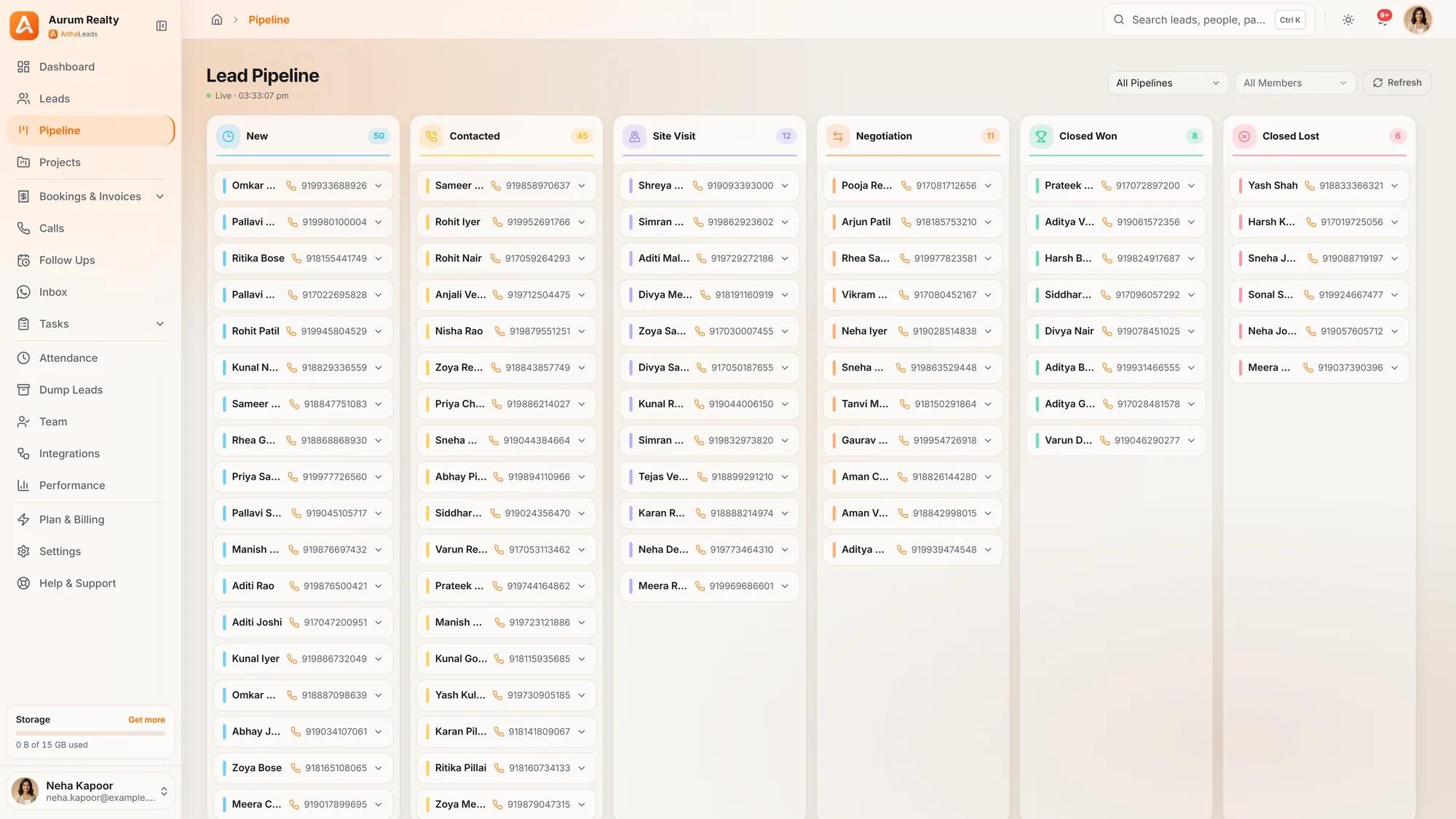
A pipeline is only useful if each stage means the same thing to everyone. A simple, practical set looks like this.
- New: enquiry received, nobody has spoken to the buyer yet.
- Contacted: you have spoken to them and know what they want.
- Site Visit: a visit is booked or done.
- Negotiation: they are discussing price, payment plan or paperwork.
- Closed Won: the booking is made.
- Closed Lost: they bought elsewhere or are no longer interested, with the reason noted.
Looking at how many leads sit in each stage shows you where deals get stuck. A pile in New means you are slow to respond. A pile in Contacted means you are not getting buyers to a visit. A pile in Negotiation may mean pricing or payment plans need a rethink. If you want to go deeper on what a CRM adds at each of these stages, read our overview of how a real estate CRM manages leads, follow-ups and sales.
The numbers that tell you real estate lead management is working
You do not need a complicated report. Five numbers, checked weekly, are enough.
- Time to first contact: how long it takes, on average, to reach a new lead.
- Contact rate: how many leads were actually spoken to, out of all that arrived.
- Site visits booked and done, by source and by person.
- Follow-ups done on time, out of all that were due.
- Bookings by source, so marketing spend follows buyers, not enquiries.
Compare these month on month. One number improving while the others hold steady usually tells you exactly which change worked.
Common real estate lead management mistakes
- Counting enquiries instead of site visits. Enquiries are cheap; visits are the real signal.
- Letting each agent keep their own list in their own phone, so leads leave when the agent does.
- Calling all of today's leads in one batch at the end of the day.
- Changing stage names every quarter, so reports never compare.
- Never marking leads as lost, so the pipeline fills with ghosts and hides the real buyers.
- Treating a repeat enquiry as a duplicate to delete, rather than a buyer who is warming up.
A simple checklist to start this week
Real estate lead management does not need a big project or a new team to get started. These five actions fit into a single week.
- List every source of enquiries and note which ones still need manual copying.
- Pick one assignment rule and tell the team.
- Agree on the six stages above and what each one means.
- Make "next follow-up date" mandatory after every conversation.
- Review the five numbers every Monday for a month.
How Arthaleads helps
Arthaleads is built around this process. Leads from Facebook lead ads, Google Ads, your website and WhatsApp arrive in one list with their source attached, duplicates are caught by phone number, and routing rules assign leads to the right person by campaign or round robin. The pipeline uses the six stages above, every move is recorded on the lead's activity log, and agents get a push notification on the Arthaleads Android app the moment a lead is assigned to them.
You can see the full list of features or compare plans and pricing. To see your own leads in one pipeline, start a free trial.
More guides on the Arthaleads blog · Arthaleads features · Pricing