
How to Measure a Real Estate Sales Team Without Micromanaging
You do not need to watch every call to know how your team is doing. Five numbers, reviewed weekly, show where deals are won and where they leak.
Arthaleads Team · · 8 min read
Anyone managing a real estate sales team faces a familiar problem. Without numbers, you end up asking people how it is going and hearing that everything is fine. With too many numbers, you spend your week in spreadsheets, and the team feels watched.
The answer is a small set of numbers that tell you the truth, reviewed on a regular day and discussed openly. This guide covers five numbers that work for most developers, brokers and channel partner teams, how to read them together, a weekly review format that does not feel like an interrogation, and what not to measure.
Why most real estate sales team reports fail
Most reports fail for one of three reasons. They count activity instead of outcomes, so people learn to look busy. They arrive too late, at the end of the month when nothing can be changed. Or they are built by hand from WhatsApp chats and call logs, so nobody trusts them.
A useful report is the opposite: a few outcome numbers, available any day, coming straight from the system the team already works in. If a number needs someone to compile it, it will be late, and it will be argued about.
1. How fast new leads are contacted
Measure the time between a lead arriving and the first contact. This is the number most closely tied to whether a buyer stays interested. A widely cited study in the Harvard Business Review found that companies contacting leads within an hour were nearly seven times as likely to have a meaningful conversation as those that waited longer.
If your average is measured in hours, fix this before anything else. If one person is slow, look at their load before their effort: a person with 80 open leads cannot respond as fast as one with 25. Our guide to real estate lead management covers assignment rules that keep the load even.
2. How many leads are actually reached
Count how many leads were spoken to out of how many were assigned. A low number can mean wrong phone numbers, poor timing of calls, or a source that produces low-quality enquiries.
The pattern by source is often more useful than the number for one person. If one Facebook campaign has a 30% contact rate and another has 70%, the problem is the campaign, not the team. Our guide to Facebook lead ads for real estate explains how form design affects lead quality.
3. Follow-ups done on time
Of the follow-ups that were due this week, how many were done by their date? This is the best single sign of discipline, and it is easy to improve once people can see it. A long overdue list also tells you someone may be carrying too many leads.
This number only works if every conversation ends with a next date. If your team does not do that yet, start there. Our real estate follow-up system sets out five simple rules that make follow-up measurable.
4. Site visits booked and site visits done
Both matter. Booked tells you how well the team converts a conversation into a plan. Done tells you how well they confirm and bring the buyer. A big gap between the two usually means a missing reminder the day before, or a visit booked without a clear time and meeting point.
Site visits are the most honest leading indicator in real estate sales. Enquiries can be bought; visits have to be earned. If you only have time to watch one number, watch this one.
5. Closings, and where they came from
Count bookings by person and by source. Over a few months you will see which campaigns, portals and channel partners produce buyers and which only produce enquiries. This is the number that should guide where you spend your marketing budget.
Be patient with this one. Property sales cycles are long, so a campaign that ran in July may only show its bookings in October. Look at rolling three-month windows rather than single months.
Read the numbers together, not one at a time
Each number on its own can mislead. Together they tell a story.
- Fast response, low contact rate: the leads themselves may be poor. Look at the source.
- High contact rate, few site visits: the conversation is not creating a reason to visit. Look at the pitch, the offer and the visit slots being proposed.
- Many visits booked, few done: confirmation and reminders are missing.
- Many visits done, few bookings: pricing, payment plans or the product itself may be the issue, not the team.
This is where measuring a real estate sales team becomes useful rather than threatening. The numbers point to the part of the process to fix, and very often that part is not a person.
A weekly review that does not feel like an interrogation
- Pick a fixed time, for example Monday morning, thirty minutes.
- Look at the same five numbers every week, for the team first and then for each person.
- Start with what went well. Name one thing each person did better than last week.
- Choose one thing to improve this week. Not five.
- Write it down, and check it next Monday.
Keep the meeting short and predictable. When people know exactly what will be discussed, they prepare, and the review becomes a habit rather than an event.
What not to measure
- Calls made, on its own. It rewards dialling, not conversations.
- Number of enquiries, on its own. It rewards cheap, low-quality leads.
- Hours online or time in a chat. It measures presence, not results.
- Messages sent. Ten forwarded brochures are not ten conversations.
Activity numbers are useful as context, for example to understand why someone's contact rate is low, but they should never be the target.
How to talk about the numbers
Share the numbers with the whole team, not only with the manager. People improve when they can see their own progress, and a number everyone can see is harder to argue with than an opinion. Treat a bad week as a question, such as what got in the way, before you treat it as a problem.
Recognise improvement, not just ranking. The person who cut their response time from four hours to forty minutes has done something more useful than the person who was already fast. And when the numbers point to a process problem, such as too many leads for one person or a campaign producing wrong numbers, fix the process first.
Setting targets that feel fair
Numbers become targets sooner or later, and badly set targets do more damage than no targets at all. A few principles keep them fair for every member of a real estate sales team.
- Base targets on the last three months, not on a wish. If the team books 20 site visits a month today, a target of 24 is a stretch; a target of 60 is a fantasy that everyone will quietly ignore.
- Adjust for lead load and lead quality. An agent working mostly portal leads and one working warm referrals should not have the same contact-rate target.
- Prefer team targets for outcomes like bookings, and individual targets for habits like response time and follow-ups on time. Bookings depend on pricing, inventory and timing that no single agent controls; habits are fully in their hands.
- Review targets every quarter, and say openly when a target was wrong. Teams trust numbers more when managers admit that a number needs changing.
Finally, tie recognition to the habits that produce bookings, not just to the bookings themselves. A month with no closings but excellent response times and follow-ups is often the month before a strong one.
Getting started
- Make sure every lead has a source, an owner and a stage.
- Make a next follow-up date mandatory after every conversation.
- Pick the five numbers above and get them from your CRM, not from a spreadsheet.
- Hold the first weekly review next Monday, and keep the same format for a month.
If you are still choosing a system, our overview of what a real estate CRM does for leads, follow-ups and sales is a good place to start.
How Arthaleads helps
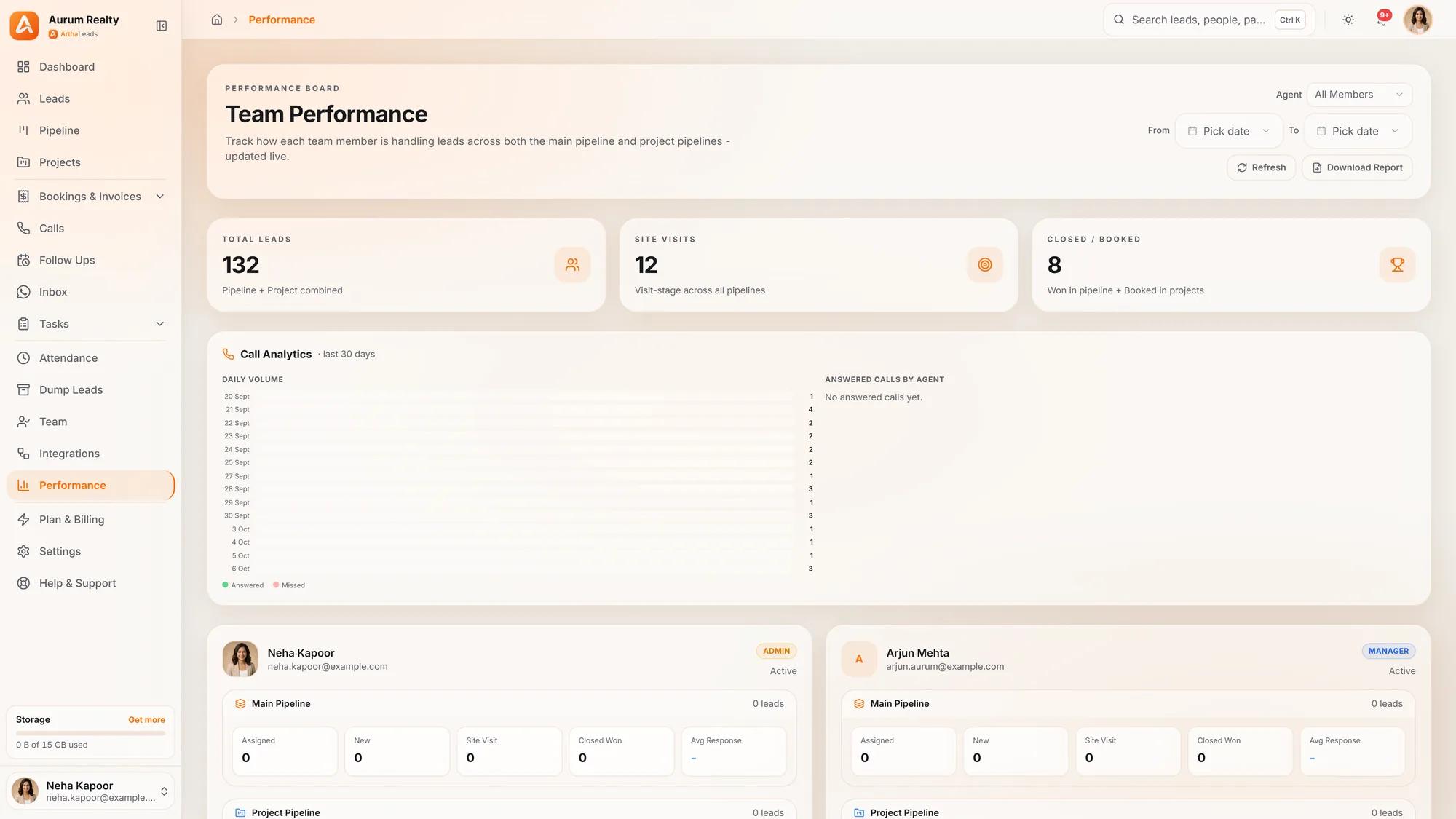
Arthaleads shows these numbers without any manual counting. The dashboard flags leads that have not been touched for seven days and shows follow-ups due. The Performance page shows each team member's calls, site visits and closings across the main pipeline and every project, with a date filter and a drill-down per person. Attendance and selfie clock-in are there too, for field teams.
Browse all features or see plans and pricing. To see your own real estate sales team's numbers in one place, start a free trial.
More guides on the Arthaleads blog · Arthaleads features · Pricing