
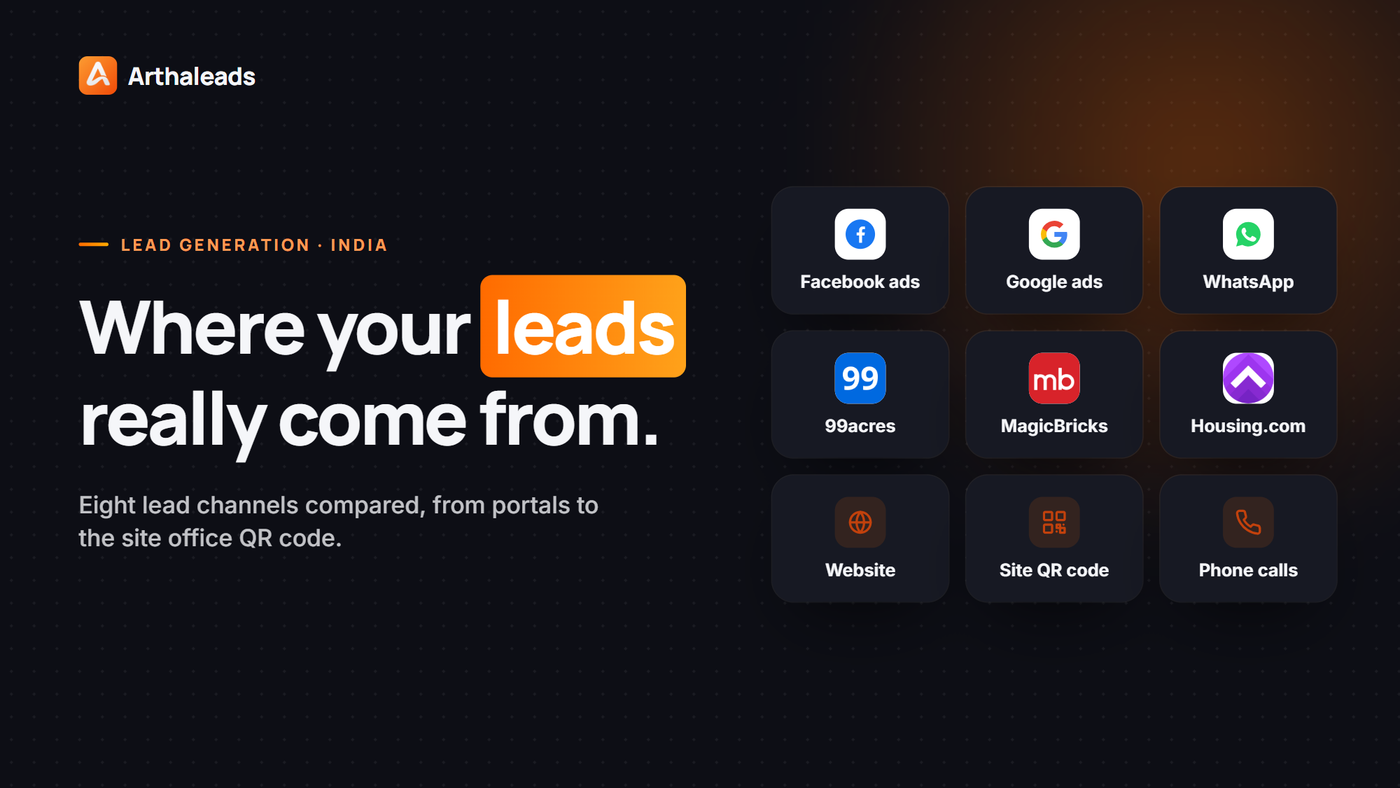
Real estate leads in India rarely come from one place. A single 2 BHK launch can pull enquiries from Facebook ads, Google search, three property portals, the website, a WhatsApp number on a hoarding, walk-ins at the sales office, channel partners and a weekend expo. Each channel brings a different kind of buyer, with a different level of intent, and each needs a slightly different response. This guide compares eight common channels on four things: how serious the buyer usually is, which signals tell you the lead is good, how fast you should respond, and how to get every enquiry into one list.
Why the source of a lead changes how you handle it
A buyer who searched "3 BHK in Baner ready possession" is in a very different place from someone who tapped a form on Instagram at midnight. Treating them the same wastes your best callers on cold leads and leaves warm buyers waiting.
Three habits make the comparison below useful in practice:
- Record the source on every lead, down to the campaign or form where possible. Without it you cannot tell which spend produces site visits rather than just enquiries.
- Match the response to the intent. High-intent channels deserve your fastest, most experienced people. Lower-intent channels need a quick, friendly qualifying message first.
- Keep one list. If each channel lives in its own sheet or inbox, the same buyer gets called twice and the one who was ready this weekend gets missed.
Paid ad channels for real estate leads
Paid ads are where most teams spend first, and they bring very different buyers depending on whether the ad interrupts someone or answers a search.
1. Facebook and Instagram lead ads
Buyer intent: mixed. These ads reach people before they start searching, so many are early in their journey.
Quality signals: a budget or configuration answer that fits the project, a preferred visit time, and a working number. Meta's lead ads page describes verification options such as checking a phone number with an SMS passcode, which helps cut fake entries.
Response time: within minutes. The buyer has just filled the form and is still on their phone. An hour later they have moved on to the next ad.
Capture: connect the form so leads arrive automatically instead of being downloaded. Our guide to Facebook lead ads for real estate covers which questions to ask on the form and how to follow up so these leads do not go cold.
2. Google search ads
Buyer intent: usually high. The person searched for something specific, such as a locality, a builder or a configuration, so they already know roughly what they want.
Quality signals: the keyword or ad group they came from, a locality that matches your project, and a budget that fits.
Response time: minutes. Search buyers are often comparing several projects in the same session.
Capture: Google Ads lead form assets let people share their contact details straight from the ad. According to Google's help page on lead form assets, CSV downloads only cover the last 30 days and leads are stored for 60 days, so if nobody exports them regularly, those buyers are lost. A direct connection to your CRM removes that risk.
Portals and your own website
3. Property portals
Buyer intent: medium to high. Portal users are actively browsing listings, but they often enquire on many projects at once, so the same person may be talking to five builders.
Quality signals: enquiries on a specific listing rather than a generic one, repeat enquiries from the same number, and buyers who mention a possession date or loan status.
Response time: within the hour, because your competitors received the same enquiry.
Capture: be honest with yourself about how portal leads reach your team. In ArthaLeads, portals such as 99acres, MagicBricks and Housing.com are not connected automatically. Portal leads are added manually or imported from a CSV or Excel sheet, so set a routine (for example, an import every morning and afternoon) and give one person the job of doing it.
4. Your own website
Buyer intent: medium to high. Someone who found your site, read about the project and filled a form has already spent time on you rather than on a listing page.
Quality signals: which page they enquired from (a specific tower or floor plan beats the home page), whether they downloaded a brochure, and any message they wrote in their own words.
Response time: within the hour, ideally much sooner during working hours.
Capture: website forms are often neglected because submissions land in an email inbox nobody watches on Sundays. If your site runs on WordPress, a form plugin that sends every submission straight to your CRM fixes this. ArthaLeads has a free WordPress plugin that works with eight popular form builders, and other sites can send leads through an API.
WhatsApp: conversations instead of forms
5. WhatsApp chats and click-to-WhatsApp ads
Buyer intent: often high. A buyer who messages you directly wants a conversation, not a form. Meta's ads that click to message open a one-to-one chat with your business on WhatsApp, Messenger or Instagram, so the first touch is already a chat.
Quality signals: specific questions about price, carpet area, possession or loans, and a willingness to share a visit date.
Response time: as close to instant as you can manage. A chat left unanswered overnight usually goes quiet. Our guide on replying to property enquiries on WhatsApp covers what a good first reply contains.
Capture: every new chat should become a lead with its source attached, not sit in one salesperson's phone. A shared inbox lets the team see and answer the same conversations; see how a WhatsApp CRM handles this, including an AI agent that can reply after hours and book visits.
Offline real estate leads: walk-ins, partners and expos
6. Walk-ins and site hoardings with QR codes
Buyer intent: high for walk-ins, medium for hoardings. A family that drove to the site on a Sunday is serious. Someone who saw a hoarding at a signal is interested enough to look, but may not be ready to talk.
Quality signals: for walk-ins, who came (the decision maker or a relative scouting), their timeline and their budget. For hoardings, whether they filled the full form or only a name.
Response time: log walk-ins before the family leaves, with a follow-up the same day. Hoarding enquiries need a reply within the hour.
Capture: a QR code on each hoarding, brochure and site board that opens a short form, so the lead arrives already tagged with its source. Walk-ins should be entered at the reception desk, not on a paper register that gets typed up next week.
7. Channel partners and referrals
Buyer intent: usually high. A channel partner or an existing customer has already done some qualifying, and a referral comes with trust attached.
Quality signals: a named partner or referrer, a buyer who has already seen similar projects, and a clear configuration and budget.
Response time: same day, with a call to the partner as well as the buyer. Partners notice who responds quickly and send their next buyer there.
Capture: log the partner or referrer on the lead so brokerage and credit are clear later.
8. Offline events and property expos
Buyer intent: mixed. Expos attract serious buyers and casual visitors in the same crowd.
Quality signals: a conversation that covered budget and timeline, a scheduled site visit, and notes from the person at the stall.
Response time: within a day of the event, before every other builder at the expo calls the same people.
Capture: skip the visitor book. Use a QR code at the stall so visitors enter their own details, and have staff add a one-line note while the conversation is fresh.
Bringing real estate leads from every channel into one list
Across all eight channels, the real estate leads that get lost are the ones sitting outside the main list, in an email inbox, a downloaded file, a paper register or a personal phone. Bringing real estate leads together means connecting the channels that can be connected and setting a fixed routine for the ones that cannot.
- Connect Facebook and Instagram lead ads, website forms and WhatsApp so leads arrive on their own.
- Import portal and expo leads on a fixed schedule, with one person responsible.
- Tag every lead with its source and campaign, and catch duplicates by phone number so one buyer is one record.
- Review site visits and bookings by source every month, not just enquiry counts, so the budget follows real estate leads that actually buy.
To see how this looks with your own projects, browse the full list of features or start a 14-day free trial and put every channel into one pipeline.
About Arthaleads
Arthaleads is a CRM for Indian real estate sales teams. It brings enquiries from ads, portals, your website and WhatsApp into one workspace, with follow-ups, projects, bookings and invoices. These articles are educational and are not a substitute for advice based on your own business and data.