
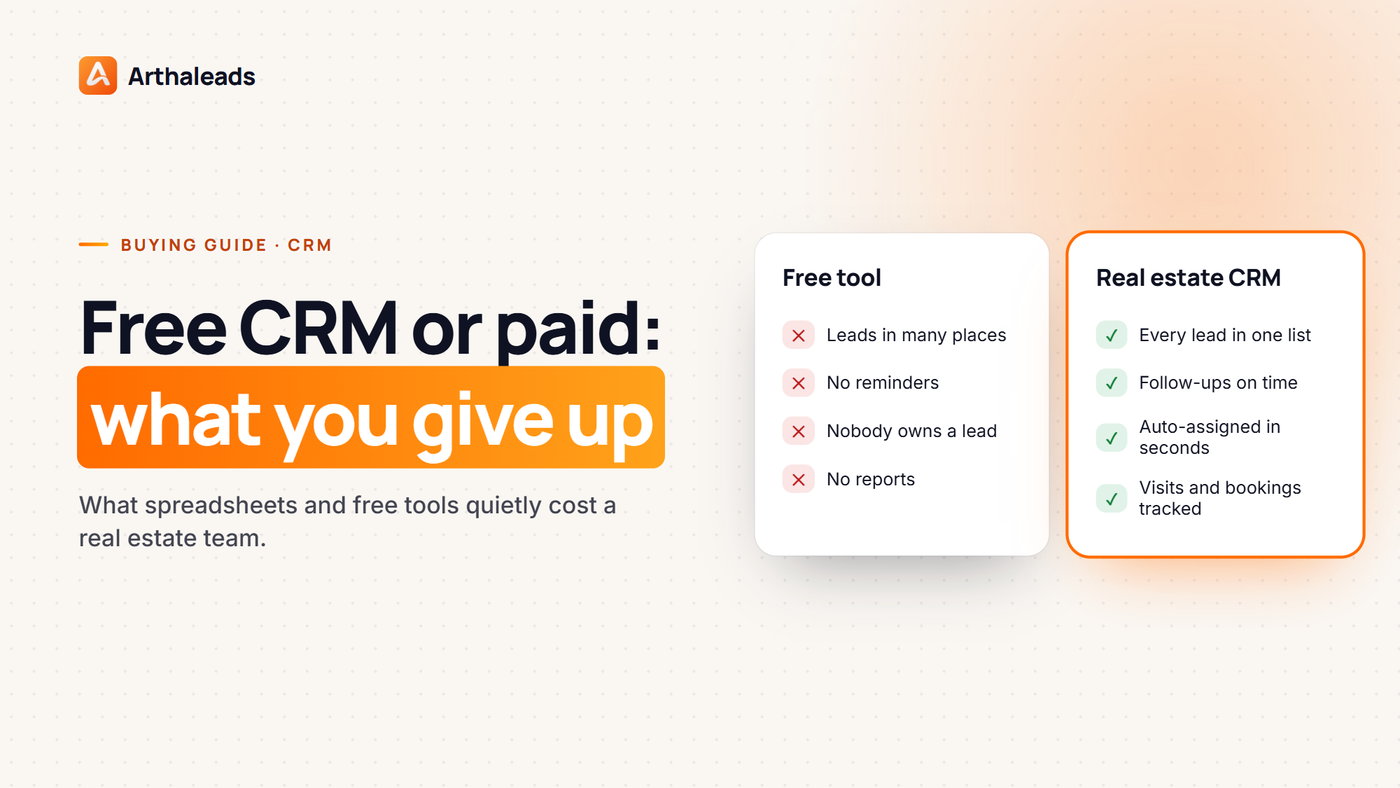
Almost every real estate team starts with free tools: a Google Sheet of enquiries, the WhatsApp Business app on the office phone, and perhaps a free CRM for real estate that someone found online. For a small team that is often the right choice. The question is not whether free tools are bad, but when they start costing more than they save. This guide looks honestly at what free tools do well, where they break as a team grows, and a simple way to decide when paying for a CRM makes sense.
What free tools do well
Free tools deserve credit. Many brokers and small developers run for years on them, and there is no shame in that.
- Excel and Google Sheets are flexible, familiar and quick to set up. Everyone on the team already knows how to filter a column. Google Sheets also lets you share a file and choose whether each person can view, comment or edit, as explained in Google's help page on sharing files.
- The WhatsApp Business app gives a business profile, greeting messages and away messages on a single number, and it is where Indian buyers already are. Its product page describes greeting people the moment they start a conversation and replying when you are away.
- Free CRM plans give you a proper lead record, a pipeline and basic reminders, usually with limits on users, records or features.
If you have one or two people, a few dozen enquiries a month and one project, these tools may be all you need. A free CRM for real estate or a well-kept sheet will serve you better than an expensive system nobody opens.
Where free tools start to break
The trouble rarely shows up on day one. It shows up when the team grows past three or four people, when a second project launches, or when lead volume jumps after a good campaign. These are the usual breaking points.
Shared access without control
A shared sheet works until someone sorts one column instead of the whole sheet, or deletes a row by mistake. Sharing settings decide who can open or edit the file, but an editor can usually see and change every row. That means every agent can see every lead, including other agents' buyers. In a team where agents are paid on bookings, that causes friction and, sometimes, leads walking out of the door.
Follow-up reminders that depend on memory
A sheet does not ring when a follow-up is due. Teams work around it with a "next call date" column and a daily filter, which works only if someone remembers to filter it every morning. Missed follow-ups are the quietest leak in real estate sales, because nobody notices a call that never happened. Our guide to a follow-up system your team will actually use covers how to fix this whatever tools you use.
Duplicates
The same buyer enquires on Facebook, then the website, then WhatsApp. In a sheet, that is three rows, and possibly three agents calling the same person. Spotting duplicates by hand is slow, and phone numbers written in different formats make it worse.
Ownership when an agent leaves
This is the most expensive failure. When leads live in an agent's personal WhatsApp, their own copy of the sheet or their phone's call log, they leave with the agent. A serious buyer who was about to visit simply stops hearing from your company. With free tools, the record of what was said, promised and planned is often in someone's head.
Reports that take a day to build
Owners want simple answers: how many leads came from each source this month, how many visited, how many booked, and who is following up on time. In a sheet, each answer is a manual exercise, so the report gets built once a quarter instead of once a week.
WhatsApp at scale
The WhatsApp Business app works well when one or two people handle the chats. When five agents need to answer chats from one number, see who replied, and hand chats over, it gets messy. Sending updates to a large, filtered list of leads is also a different job. Meta's WhatsApp Business Platform is the API route meant for larger businesses and can connect with CRM systems, but you need software on top of it to use it as a team.
What a paid real estate CRM adds
A paid CRM is not magic. It is the same process (capture, assign, follow up, visit, book) with the manual parts taken away. For real estate specifically, the useful additions tend to be:
- Leads from ads, website forms and WhatsApp arriving in one list on their own, with the source recorded.
- Role-based access, so agents see only their own leads and managers see the team.
- Follow-up reminders that alert the agent, with overdue items clearly flagged.
- Duplicate detection by phone number.
- A shared WhatsApp inbox, so chats belong to the company rather than to one phone.
- Reports on sources, visits and bookings without building them by hand.
- Data kept separate per company, with controls over who can export it. You can read how ArthaLeads approaches this on its security page.
ArthaLeads, for example, adds a WhatsApp CRM with a shared inbox, campaigns to filtered lead lists and an AI agent that can reply after hours and book site visits. Other real estate CRMs package things differently, and some offer free plans of their own. If you are weighing that option, see a comparison with a CRM that has a free plan.
When a free CRM for real estate is enough: a simple test
You do not need a spreadsheet model to decide. Answer these five questions honestly.
- Do more than three people work on the same leads?
- Has a lead ever been called by two agents, or by nobody?
- When an agent left, did you lose track of any of their buyers?
- Can you say, within five minutes, how many site visits each source produced last month?
- Does more than one person need to answer WhatsApp chats from the same number?
If you answered "no" to all five, stay with free tools and keep them tidy. A free CRM for real estate or a disciplined sheet is fine at your size. If you answered "yes" to two or more, the free tools are already costing you something, even if it does not show up on an invoice.
The cost of a missed lead: a thought exercise
The real price of free tools is not zero. It is the bookings you never hear about. Here is a simple way to think about it, using made-up numbers that you should replace with your own.
Say a hypothetical project gets 300 enquiries a month. Suppose that, because of missed follow-ups and duplicate confusion, 10% of them never get a proper second call. That is 30 buyers a month who were not followed up.
Now suppose that, on your own past data, one in every 50 enquiries ends in a booking. Then those 30 lost buyers might represent, on average, a little more than half a booking a month, or six or seven bookings a year.
Multiply that by your brokerage or margin on a typical unit. For most teams, even one extra booking a year is worth far more than the yearly cost of a CRM for a small team. These figures are only an illustration, not a prediction. The point is to run the exercise with your real conversion rate and your real margin, and see where the line falls.
Questions to ask in a CRM demo
A demo shows a product at its best. These questions show how it would fit your team, and the answers are worth getting in writing before you sign:
- Can it bring in leads from the exact sources we use, such as Facebook lead ads, our website forms and the portals we pay for?
- What happens to a lead, its notes and its chat history when the agent handling it leaves?
- Can an agent see only their own leads, and can we control who exports data?
- How does WhatsApp work: one shared business number for the team, or each agent’s own phone?
- Can we export all our leads and history if we leave, and in what format?
- What is the full price for our team size, including GST and any minimum number of users?
Making the switch without losing what works
If you decide to move, keep what free tools taught you. Your sheet columns show which fields your team actually uses. Your WhatsApp habits show how buyers like to talk to you. Import your existing sheet into the CRM, keep the same stage names your team already understands, and change one habit at a time.
Start with lead capture and follow-up reminders, because that is where most leaks are. Add WhatsApp, reports and automation once the team is comfortable.
ArthaLeads plans start at Rs 599 per user per month plus GST, with a minimum of five users, and you can compare what each plan includes on the pricing page. If you would rather test it on your own leads first, start a 14-day free trial with every Growth feature and no credit card.
Frequently asked questions
Is there a free CRM for real estate in India?
Yes. Several CRMs offer free plans, usually with limits on users, records or features, and many small teams run on Google Sheets with the WhatsApp Business app. These work well for one or two people and one project; the gaps appear with more agents, more lead sources and more WhatsApp chats.
Is Excel good enough as a real estate CRM?
For a small team with a few dozen enquiries a month, often yes. Excel and Google Sheets struggle with follow-up reminders, duplicate buyers, access control and keeping leads when an agent leaves, and those are usually the reasons teams move to a CRM.
How much does a real estate CRM cost in India?
Prices vary widely by vendor and plan, and most charge per user per month. ArthaLeads plans start at Rs 599 per user per month plus GST, with a minimum of five users. When comparing, look at what each plan includes for your team size, not just the headline price.
What should a small real estate team look for in its first paid CRM?
Start with the basics that stop leads leaking: automatic lead capture from the sources you already use, follow-up reminders, duplicate checks by phone number and role-based access. A shared WhatsApp inbox matters as soon as more than one person answers buyer chats.
How long does it take to move from spreadsheets to a CRM?
A small team can usually import its sheet and start working in a CRM within a few days. Clean the sheet first, with one row per buyer, phone numbers in one format and a clear owner for each lead, then connect your lead sources one at a time.
About Arthaleads
Arthaleads is a CRM for Indian real estate sales teams. It brings enquiries from ads, portals, your website and WhatsApp into one workspace, with follow-ups, projects, bookings and invoices. These articles are educational and are not a substitute for advice based on your own business and data.