

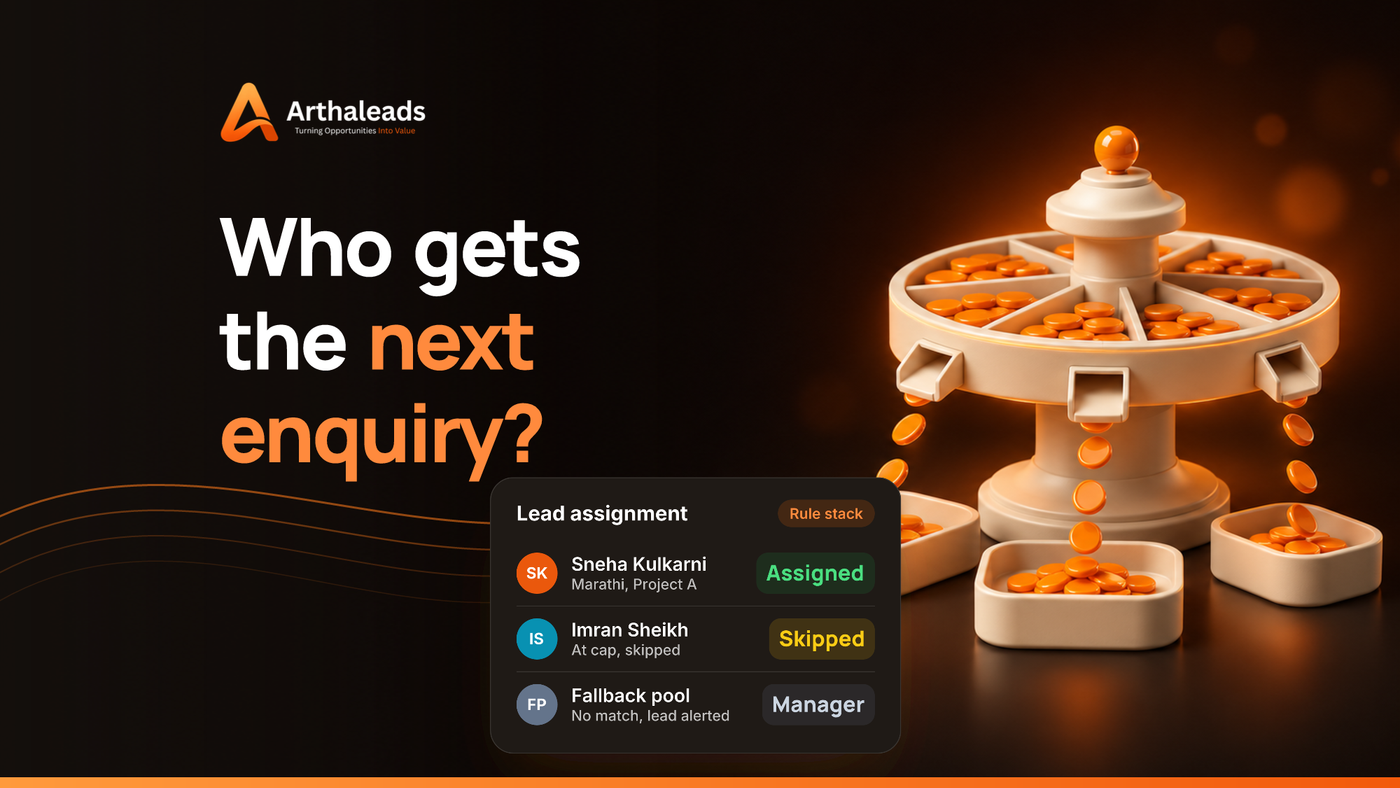
When 40 enquiries land in one afternoon after a Meta ad or a portal burst, someone has to decide who calls whom, and that decision is usually made in a WhatsApp group. Lead distribution software makes it automatically, using rules you set, so every enquiry has an owner within seconds.
The one question here is who gets the next property enquiry on an Indian developer or broker team. We compare round robin, project-wise, skill-based and capped rules, show how to stack them, and end with a checklist you can run against any CRM.
These are operating choices for your team, not compliance items. The one legal link is data protection: limiting who can see a lead's details is good practice under the DPDP Act.
What is lead distribution software and is it a CRM?
Lead distribution software is a tool that assigns each new lead to a salesperson automatically, using preset criteria such as next available rep, expertise, capacity or location, according to Pipedrive's product page. In real estate it is usually a feature inside your CRM, and it works the moment an enquiry arrives.
The term has a second meaning that does not apply to you. boberdoo describes its lead distribution software as a system that receives, qualifies, prices and routes leads to buyers, which suits companies that sell leads. If you are sharing enquiries among your own telecallers and sales executives, you need the first meaning, not this one.
It is also not the same as a CRM. A CRM stores the lead, its history and its follow-ups, while distribution decides who owns it. Many Indian real estate CRMs list auto-assignment as a standard feature, so you rarely need a separate tool.
Why does who gets the lead matter?
The owner decides how fast the first call happens, whether work is shared fairly and whether a lead gets lost between desks. A lead with no clear owner is called late, called twice or not called at all. Assignment is the first control point in your pipeline, and every later step depends on it.
According to InsideSales' 2021 research, which reviewed over 55 million sales activities on 5.7 million inbound leads at 400+ companies, conversion rates dropped 8x after 5 minutes. This is US B2B data, not an Indian property benchmark. It still supports a simple point: a lead waiting for someone to pick it up goes cold.
- Speed: an assigned lead has a person and a clock, so the first call is not left to whoever notices it.
- Fairness: if good leads reach only a few people, the rest stop trusting the system and cherry-pick from the sheet.
- Leakage: leads sitting in shared sheets or WhatsApp groups get called twice or never.
Which rule should you use: round robin, by project or by skill?
Use project-wise rules as the first filter if you run several launches, round robin to share work inside each group, and skill or language rules only where a mismatch loses the buyer. No single rule fits every team, so most combine them. The table shows what each rule is good at and where it breaks.
| Rule | Works best when | Where it breaks |
|---|---|---|
| Round robin | Telecallers have similar roles and languages | Ignores skill, performance, leave and workload |
| Project-wise | Several launches with separate teams | One team idle on a quiet project, another overloaded on a hot one |
| Language or skill | Hindi, Marathi, English, NRI or commercial buyers need a specific person | Your best closer gets overloaded |
| Capacity-capped | Portal and Meta ad bursts | Leads stall if everyone is at the cap and there is no fallback pool |
Luxury Presence, a US real estate vendor, says round robin gives fairness and a clear audit trail, works best when agents have similar roles and response expectations, and that equal volume ignores performance, specialisation and schedule. It suggests territory first, round robin inside the territory, then a catch-all pool. For India, read territory as project.
Microsoft's Dynamics 365 documentation separates round robin, which goes to the seller who has waited longest, from load balancing, which considers workload. For telecallers, load balancing is closer to what you want on a busy day. Route by language or budget band only where it matters, and cap the open leads of your best closer so skill-based routing does not burn them out.
How do you handle shifts, leave and lead bursts?
Mark attendance or shift status in the CRM and let the rule skip anyone who is off, on leave or already holding too many open leads. Without this, round robin keeps feeding an absent telecaller, and those enquiries sit unanswered until someone notices. Set the cap, the shift hours and a night policy before you switch the rule on.
- Capacity cap: limit untouched or open leads per person. For example, a cap of 20 untouched leads (a sample figure) stops one person collecting a backlog.
- Shifts and leave: skip people marked absent, and decide who covers a team lead's leads when they are away.
- Night enquiries: decide whether they queue for the first shift, with an acknowledgement on WhatsApp, or go to a night desk.
- Bursts: say a Meta campaign sends 60 enquiries in an hour to 4 telecallers: plain round robin gives each 15 untouched calls at once. A cap of 8 (as a sample) sends the overflow to a fallback pool and alerts the team lead.
Portal leads arrive in bursts too, so pair these rules with the reply habits in our guide on replying to portal leads fast.
Who owns the lead at each stage, and which rule wins for duplicates?
Decide one owner per stage: presales owns the lead until a qualified site visit is booked, then sales owns it through the visit and negotiation. Duplicates and channel partner enquiries need a written priority rule, because a CRM can only apply what you define. Your sales head should set it, not the telecaller.
| Stage | Owner | Handoff trigger |
|---|---|---|
| New enquiry | Presales telecaller | First contact made within your response window |
| Qualified, visit booked | Sales executive | Visit confirmed with date and project |
| Site visit done | Sales executive | Visit marked done at the site |
| Negotiation and booking | Sales executive or closer | Booking amount received |
For duplicates, a common rule is to attach the new enquiry to the existing lead and keep the original owner, instead of creating a second lead for a second person. Channel partner conflicts are harder. Registration validity periods vary by developer, so there is no standard number. Write your own rule, for example: a lead registered by a channel partner stays linked to that partner until the validity period you have agreed expires.
Roles and headcount are covered in our guide to real estate sales team structure.
A rule stack for a 12-person developer team
A rule stack is the order in which rules are checked, and the first one that matches decides the owner. For a developer with two projects and 12 people, a sensible order is project, then language, then round robin among available people, then a fallback pool. The setup below is a sample, not a benchmark.
Project
A lead from Project A's Meta ad goes to the Project A team. A commercial enquiry goes to the Project B team.
Language
A Marathi enquiry goes to the Marathi-speaking telecaller if they are available and under the cap.
Round robin
All other leads rotate among available telecallers, skipping anyone on leave, off shift or at the cap.
Fallback pool
If nobody qualifies, the lead goes to a manager's pool and the team lead is alerted.
Why bother? Say the team gets 300 leads a month and each costs ₹800 in ad spend: that is ₹2.4 lakh of spend. If 10% of those leads (30) are called a day late or not at all, ₹24,000 of that spend has been wasted before any selling starts. The figures are assumed, so put in your own cost per lead.
What happens when nobody responds?
Set a first-touch timer. Microsoft's documentation notes that assignment rules can have a time limit, and the same idea applies here: if a lead is untouched after, say, 10 minutes, requeue it to the next eligible person and notify the team lead. Log a plain reason on every assignment, such as 'Project A, Marathi, next in rotation', so anyone can answer 'why did this lead go to me?'.
Timers handle the first call. For the days after, use the cadence in our follow-up system guide.
Checklist: 10 things to test in any lead distribution software
Test assignment during a free trial with sample leads before you commit, because feature lists say 'auto lead distribution' without saying how it behaves. Create five test users, send leads from every source, and tick each item below. Our guide to what to test in a 14-day CRM trial covers the rest of the product.
- Rules can be set by project, source, language and budget band.
- Rules run in a fixed priority order that you control.
- A fallback pool catches leads that match nothing.
- Users on leave or off shift are skipped automatically.
- You can cap open or untouched leads per person.
- An untouched lead requeues after a timer you set, with an alert.
- A duplicate enquiry attaches to the existing lead and owner.
- Each assignment shows a readable reason.
- Managers can reassign in bulk and see the full assignment history.
- Meta, WhatsApp, website and imported portal leads all pass through the same rules, and each user sees only the leads they should.
How this looks in Arthaleads
Arthaleads is real estate CRM software for builders, developers, channel partners and brokers in India. It brings enquiries from Facebook and Instagram lead ads, WhatsApp chats, website forms and CSV imports of 99acres, MagicBricks and Housing.com leads into one place, then assigns each lead to the right person and reminds them to follow up.
Developers get project-wise pipelines and site QR codes, so a lead is tracked from first call to site visit and booking. Check the exact assignment options against the checklist above during the 14-day Growth trial, which needs no credit card. As of November 2026, Arthaleads costs ₹599 (Starter) or ₹999 (Growth) per user per month plus 18% GST, with a five-seat minimum.
To test assignment on your own leads, start from the lead management software page.
Frequently asked questions
What is round robin lead assignment, and is it fair?
Round robin gives leads to each person in turn, so everyone gets a similar number. It is fair on volume and easy to audit. It ignores skill, language, performance and who is on leave, so it works best combined with other rules.
How do I distribute leads among telecallers in real estate?
Start with project, so each launch has its own team. Then apply language rules where needed, rotate the rest by round robin among available people, and keep a fallback pool. Add a cap on untouched leads so nobody is overloaded.
Can leads be assigned by language, such as Hindi or Marathi?
Yes, if your CRM supports language or skill rules and you tag each telecaller with the languages they speak. Check that the rule falls back to another person when the matching telecaller is on leave or at the cap.
What happens if a salesperson does not call a new lead?
With a first-touch timer, the lead is requeued to the next eligible person and the team lead is alerted. Without one, the lead sits with the original owner until someone spots it. Set the timer length based on how fast your team can realistically respond.
Do I need a separate tool for lead distribution, or does my real estate CRM include it?
Most real estate CRMs include assignment as a feature, so a separate tool is rarely needed. What differs is depth: rule order, caps, shift awareness, timers and duplicate handling. Test those in a trial rather than trusting the feature list.
About Arthaleads
Arthaleads is a CRM for Indian real estate sales teams. It brings enquiries from ads, portals, your website and WhatsApp into one workspace, with follow-ups, projects, bookings and invoices. These articles are educational and are not a substitute for advice based on your own business and data.