
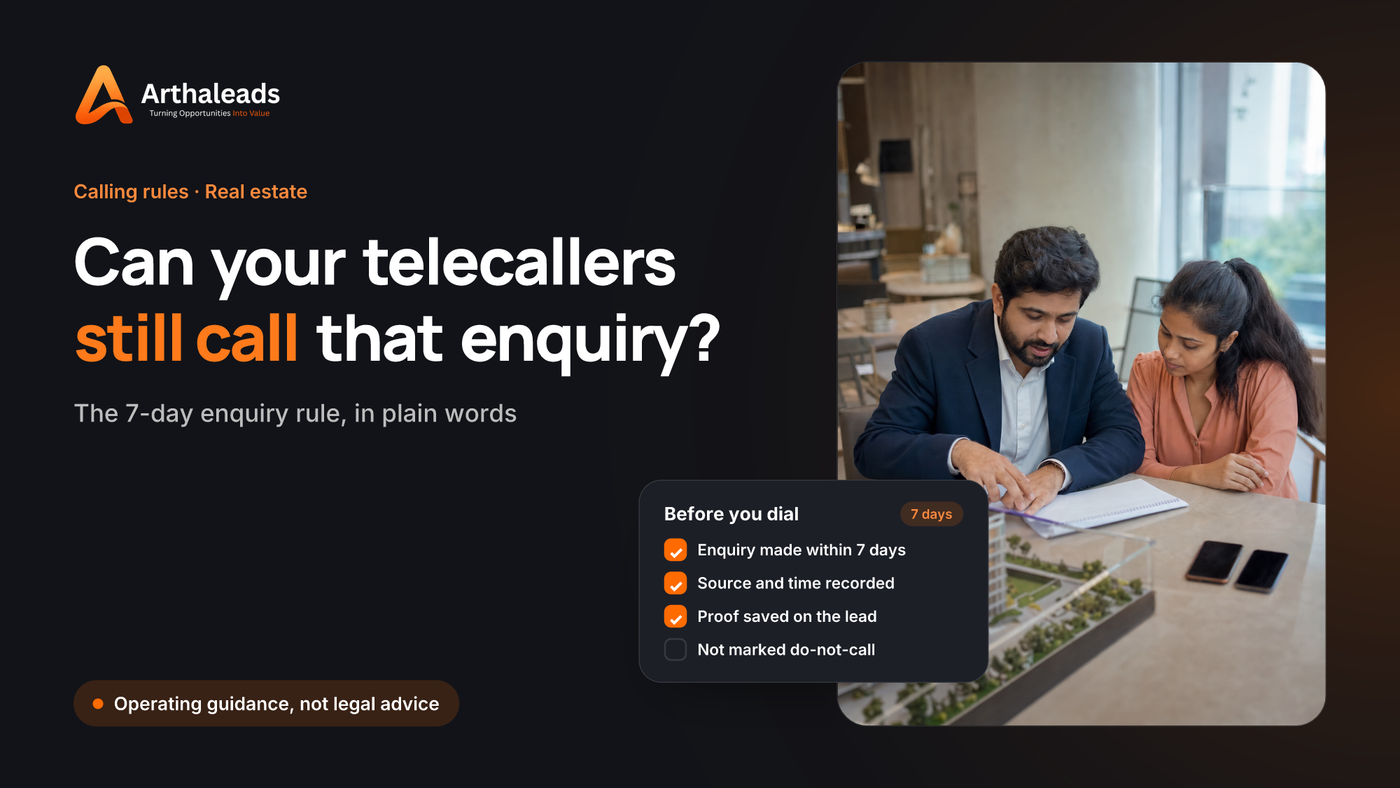
Your telecallers ring 99acres, Meta and website enquiries every day, and until recently nobody asked how old the enquiry was. The TRAI rules for real estate calls now put a clock on that habit. After the Third Amendment of September 2026, an enquiry gives you a basis to call for only seven days, and only if you can prove it.
This article turns the rule into daily operating guidance for a property sales team. It covers what counts as proof, how to redesign your follow-up cadence, what to do with older leads and cold lists, and how one team's habits can affect every number your company owns.
This is operating guidance, not legal advice. Where the rules are unclear we say so, and we link the TRAI documents so you can read them yourself.
TRAI rules for real estate calls: what changed in September 2026
TRAI notified the Telecom Commercial Communications Customer Preference (Third Amendment) Regulations, 2026 on 18 September 2026, announced in Press Release No. 119/2026. For a property team, the part that matters is how the regulation treats a relationship based on an enquiry.
As we read the regulation text, an enquiry-based relationship counts only if all three of these hold:
- The enquiry was made in the seven days immediately before the call or message.
- Neither party has terminated the relationship.
- The enquiry was made in writing or through digital means, and the sender keeps it 'in a verifiable form'.
Read the clause in the full PDF before you brief your team, because our reading is of the published text and not a legal opinion. TRAI's consultation draft of 13 March 2026 shows the intent: it said it wanted to remove 'inquiry' from the relationship definition 'to avoid the nuisance of UCC' (unsolicited commercial communication).
On timing, the regulation says most provisions come into force 30 days after Gazette publication, while regulations 4, 6, 8(a) and 18 follow after 60 days. A secondary tracker, thetelephony.co, puts the enquiry rule in the first stage, around 18 October 2026, but that is not an official calendar. Confirm the dates against the Gazette, and plan as if the rule is already live.
Two more points come from secondary sources that cite the regulation, so verify them too. They say autodialled, robo, pre-recorded and AI-voice calls are now covered as A2P calls, which matters if your team uses an auto-dialler. They also say the amendment states that TCCCPR does not exempt senders from the DPDP Act, 2023.
The basics every telecaller should know
Before the new rule, there are a few settled basics. Every telecaller on your team should be able to say these back to you.
- DND categories. According to the TRAI FAQ on unsolicited commercial communications, a customer can block all commercial communication or choose from seven categories, and Real Estate is one of them.
- Checking and complaining. Anyone can check a number through the DND app or an SMS to 1909. Complaints go through 1909 or the app.
- What 'promotional' means. TCCCPR 2018 defines a promotional voice call as a commercial call for which the sender has not taken explicit consent. So the real question is always whether you hold consent or a valid enquiry relationship.
- Number series. The February 2025 Second Amendment bars ordinary 10-digit numbers for telemarketing. Per PIB, the 140 series continues for promotional calls and the 1600 series is for transactional and service calls.
- No 1600 for you. According to Medianama's report on TRAI's July 2026 clarification, 1600xx is reserved for entities regulated by the RBI, SEBI, IRDAI and PFRDA and for government calls. A private property seller is not eligible.
- 140 calls. The same clarification says 140 calls cannot be tagged or filtered, and can be blocked only if the customer opted out of promotional calls for that sector in the DND registry. Entities must register with their telecom provider first.
- Calling hours. Secondary compliance guides cite 9 AM to 9 PM as the calling window. We could not check this against the primary TCCCPR 2018 text, so verify it, and in practice keep every call inside those hours.
The 7-day window and what counts as proof
Take a lead who enquires on a Monday at 11 AM. For example, calls and follow-ups to that buyer in the following seven days sit inside the window. After that, the enquiry alone no longer gives you a basis to call.
The harder question is proof. The regulation asks that the enquiry be kept in verifiable form, so your team should be able to show when the buyer enquired, through which channel, and for which project. Here is how that looks by source.
| Lead source | Proof you can show | When the 7 days start | After day 7 |
|---|---|---|---|
| 99acres, MagicBricks, Housing.com | Portal alert or export with enquiry date and time | The buyer's enquiry time on the portal, not your CSV upload date | Re-permission, or stop |
| Meta lead ads | Form submission with timestamp and the form fields | Form submission time | Re-permission, or stop |
| Website or Google form | Stored submission with date, time and page | Submission time | Re-permission, or stop |
| WhatsApp inbound | The buyer's own message in the chat | Time of the buyer's message | A fresh enquiry from the buyer starts a fresh window |
| Walk-in or site visit | Signed visitor register entry with date | Date of the visit | Ask permission in writing, and confirm your approach with a lawyer |
| Referral from a friend or customer | Usually nothing from the buyer themselves | No enquiry to you, so no clock | Treat as cold until the person confirms interest in writing |
| Channel partner or bought list | Nothing from the buyer | No clock | Do not cold call; ask the partner for proof of the buyer's enquiry |
One trap deserves a mention. If you import portal leads from a CSV, the upload date is not the enquiry date. Keep the buyer's original enquiry time on the lead, or your 7-day count will be wrong from day one.
We did not find a stated retention period for this proof in the sources we reviewed. A sensible habit is to keep it for as long as you keep contacting the person, and to ask your lawyer how long beyond that.
Older leads, cold lists, referrals and site visit follow-ups
Most property teams make their money on leads that are two weeks or two months old. The new rule does not stop you working them. It changes how you restart the conversation.
Leads older than 7 days
Send a short message through WhatsApp or a form asking whether the buyer still wants details of the project. A reply is a fresh digital enquiry with its own timestamp, and your 7-day window starts again. WhatsApp itself is governed by WhatsApp Business policy and the DPDP Act, not by this rule, so message only people who contacted you or opted in. Our guide to replying to property enquiries on WhatsApp covers the reply side.
If there is no reply, stop calling. A buyer who stays silent after a re-permission message has told you something, and a complaint is the likely next step.
Cold lists and old project databases
Bought lists, partner-shared lists and a closed project's old database are people who never enquired with you. A call to them without explicit consent fits the definition of a promotional voice call. Do not run these from ordinary numbers, and check them against the DND registry, including the Real Estate category, before anyone dials.
Referrals and 'we met at the site visit' calls
A referrer giving you a number is not the buyer making an enquiry. Ask the buyer to confirm interest in writing, even with a one-line WhatsApp reply. For site visits that happened weeks ago, our research did not settle how the 7-day limit applies, so the safe approach is a signed register entry plus a written re-permission.
Once you know the window, redesign your cadence around it. The heavy contact belongs inside the seven days:
Day 0
Reply within minutes and attempt the first call. Our piece on [replying to portal leads before competitors do](/blog/property-portal-leads-reply-fast) shows how.
Day 1
Second call attempt and a WhatsApp message with project details, if the buyer has messaged you or opted in.
Days 2 to 4
Fix the site visit slot, and send a confirmation once it is agreed.
Days 5 to 6
Final call attempts, and ask whether the buyer wants to continue receiving calls.
Day 7 onwards
Call only if the buyer has re-enquired or given written permission. Otherwise move the lead to a low-contact list.
For the wider follow-up process, see a real estate follow-up system your sales team will actually use.
Personal SIMs, 10-digit numbers and what is still unclear
Many property telecallers still dial from personal or company-issued ordinary mobile numbers. The February 2025 Second Amendment says senders may not use normal 10-digit numbers for telemarketing. The open question is whether a person-to-person callback to a fresh enquiry counts as 'telemarketing' at all.
We did not find that settled in the text we reviewed. Third-party blogs say an enquiry callback is 'generally fine', but the 7-day limit tightens that. Read it as 'within seven days, with proof', not as blanket permission.
Until you have clarity, write to your telecom provider or lawyer and ask. Meanwhile, these points remain open:
- Whether callbacks to enquiries from ordinary numbers need a 140 number.
- How long enquiry proof must be retained.
- How the 7-day limit applies to walk-ins and old site visits.
- The exact commencement dates of each provision.
- How the rule treats WhatsApp messages sent after an enquiry.
Practical steps help regardless. Keep a list of every number your team uses for calling and who owns it. Never run cold lists from personal SIMs, and do not use an auto-dialler without checking how it is classified.
Why one bad calling habit can cut off the whole team
The enforcement side is where a single careless telecaller becomes a company problem. Per the PIB note on the February 2025 changes, a customer can now complain within 7 days of receiving spam, up from 3 days, and prior DND registration is no longer needed. Operators must act against unregistered senders within 5 days, down from 30.
The action threshold is now 5 complaints against a sender within 10 days, down from 10 complaints in 7 days, according to TRAI Press Release No. 11 of 2025. For the first violation, the sender's outgoing services on all telecom resources are barred for 15 days. Repeat violations can mean disconnection for up to a year.
Read 'all telecom resources' as a warning. If your telecallers dial from numbers registered to the company, a handful of complaints about one person's habits could affect every number the company holds. According to Medianama's February 2026 report, TRAI issued over 731,000 notices to unregistered telemarketers in 2025, and consumers filed 3.1 million UCC complaints that year.
Secondary summaries of the September 2026 press release add that operators now use AI and ML to flag numbers, with five or more flagged numbers of a sender in ten days triggering investigation. The ₹2 lakh financial disincentive in the 2025 release applies to telecom operators, not to builders or brokers. It still gives operators a reason to act quickly against senders who attract complaints.
A one-page checklist for the sales manager
Print this and review it monthly with your pre-sales head.
- Every lead carries its source and the buyer's original enquiry date and time.
- Telecallers can see the 7-day window and call within it.
- Older leads get a written re-permission message before more calls.
- An opt-out or do-not-call flag is set the moment a buyer asks to stop, and nobody calls a flagged lead.
- Cold, bought and partner-shared lists are checked against DND, including the Real Estate category, before any call.
- Calls happen only within the permitted hours (verify 9 AM to 9 PM).
- A list of calling numbers and their owners is kept, and personal SIMs are not used for cold lists.
- One named person handles complaints and replies to the telecom provider.
- Lead data handling matches your DPDP Act obligations.
On the last point, a buyer's phone number is personal data. Collect only what you need, record where it came from, and honour opt-outs on every channel. The DPDP Act deserves its own article, but your calling records are already part of that picture.
How to build this into your CRM routine
The rule is easiest to follow when the evidence already sits on the lead. Whether you use a spreadsheet, a free tool or paid software, check that these four things happen every time:
- Record the enquiry source and the original timestamp on every lead at the moment it arrives.
- Set follow-up reminders that fall inside the seven days, and review leads approaching day 7 each morning.
- Keep a do-not-call flag on the lead record, visible to the telecaller before dialling.
- Log every call outcome, so you can show the sequence of events if a complaint arrives.
In Arthaleads, enquiries from Facebook and Instagram lead ads, WhatsApp chats, website forms and imported portal leads land in one place, with the source on each lead. Leads are assigned to a person, follow-up reminders are set, and call transcripts are available. Those are the records you would pull up if someone asked for proof of an enquiry. It is not a compliance guarantee, and DND checks remain part of your own process. For the full journey from enquiry to visit, see real estate lead management from first enquiry to site visit.
If you want to see how this would run for your team, you can book a demo and bring your current process along.
Frequently asked questions
Can real estate agents call numbers on DND?
A promotional call to a number without explicit consent is the situation the DND system is meant to prevent. Customers can opt out of all commercial communication or pick categories, and Real Estate is one of seven. A recent enquiry (within seven days, with proof) is the basis the new rule recognises, so check your approach with your telecom provider or a lawyer.
Can I call a lead on DND who filled my enquiry form?
Under the Third Amendment, an enquiry-based relationship counts only if the enquiry was made in the seven days before the call and is kept in verifiable form. So a call within seven days, with the form submission as proof, is on the firmer side. After seven days you need a fresh enquiry or written permission.
How long can I keep calling someone after they enquire?
The regulation text says the enquiry must have been made in the seven days immediately before the communication. Plan your follow-up calls inside that window. Beyond it, ask the buyer for permission through WhatsApp or a form before continuing.
Do builders need a 140-series number, and can they use 1600?
According to Medianama's report on TRAI's July 2026 clarification, 1600xx numbers are reserved for entities regulated by the RBI, SEBI, IRDAI and PFRDA and for government calls, so private real estate sellers are not eligible. The 140 series is for promotional calls. Whether an enquiry callback from an ordinary number needs a 140 number is not settled in what we found, so ask your telecom provider.
How many complaints before my company's numbers get blocked?
TRAI's 2025 rules set the threshold at 5 complaints against a sender within 10 days. For a first violation, the sender's outgoing services on all telecom resources are barred for 15 days. Repeat violations can lead to disconnection for up to a year.
Do these rules apply to WhatsApp messages too?
Our research does not settle this. Some secondary sources describe the amendment as covering 'calls and messages', but WhatsApp is also governed by WhatsApp Business policy and the DPDP Act. Treat WhatsApp as a separate compliance question and message only buyers who contacted you or opted in.
About Arthaleads
Arthaleads is a CRM for Indian real estate sales teams. It brings enquiries from ads, portals, your website and WhatsApp into one workspace, with follow-ups, projects, bookings and invoices. These articles are educational and are not a substitute for advice based on your own business and data.