You have 10,000 property leads in a sheet and a launch next week, and the obvious plan is to send everyone a WhatsApp message. That is where most WhatsApp marketing for real estate goes wrong: the wrong list, the wrong template type, a bill nobody estimated, and then messages that quietly stop arriving.
This article covers only the outbound side, meaning messages your team sends first: launches, offers, site-visit invites and cold-lead revival. It tells you which leads you can message, which template type each message falls under, what it costs in 2026, and how often you can send before WhatsApp pushes back.
We rely on Meta's own policy and pricing pages wherever possible. Where the rupee rates come from secondary sources, we say so, so please check Meta's rate card before you fix a budget.
What WhatsApp marketing for real estate means (and what it does not)
Here, WhatsApp marketing means business-initiated messages: you write to a lead who has not just written to you. A new project announcement, a festival offer, a site-visit invite and a nudge to a lead who went silent three months ago all fall in this group.
Replying to a buyer who messages you first is a different job, with different rules and different urgency. We cover that in How to Reply to Property Enquiries on WhatsApp in Minutes, Even at 1 AM, so this article does not repeat it.
WhatsApp Business app broadcast vs the API
Most small brokers start with broadcast lists in the free WhatsApp Business app. Larger teams move to the WhatsApp Business API, which is accessed through a provider. The table shows where each one stops working.
| Point | Business app broadcast | Business API |
|---|---|---|
| Best suited to | One broker or a very small team | Teams with a lead database and several callers |
| Who receives it | Broadcast lists, with a size cap and a saved-contact requirement (check WhatsApp's help centre for current limits) | Opted-in contacts, sent as approved templates |
| Template approval | None | Every template is pre-approved by Meta |
| Cost | App is free | Meta's per-message charge plus any provider fees |
| Tracking | Manual, phone by phone | Delivery and replies can be logged against a lead record |
| Where it stops | List size, no shared inbox, no audit trail of consent | Needs setup, and sending volume is governed by messaging limits |
According to Infobip's template compliance guide, business-initiated messages sent outside the 24-hour customer window must use pre-approved templates. That is the rule that shapes everything below.
Who you can message: opt-in rules by lead source
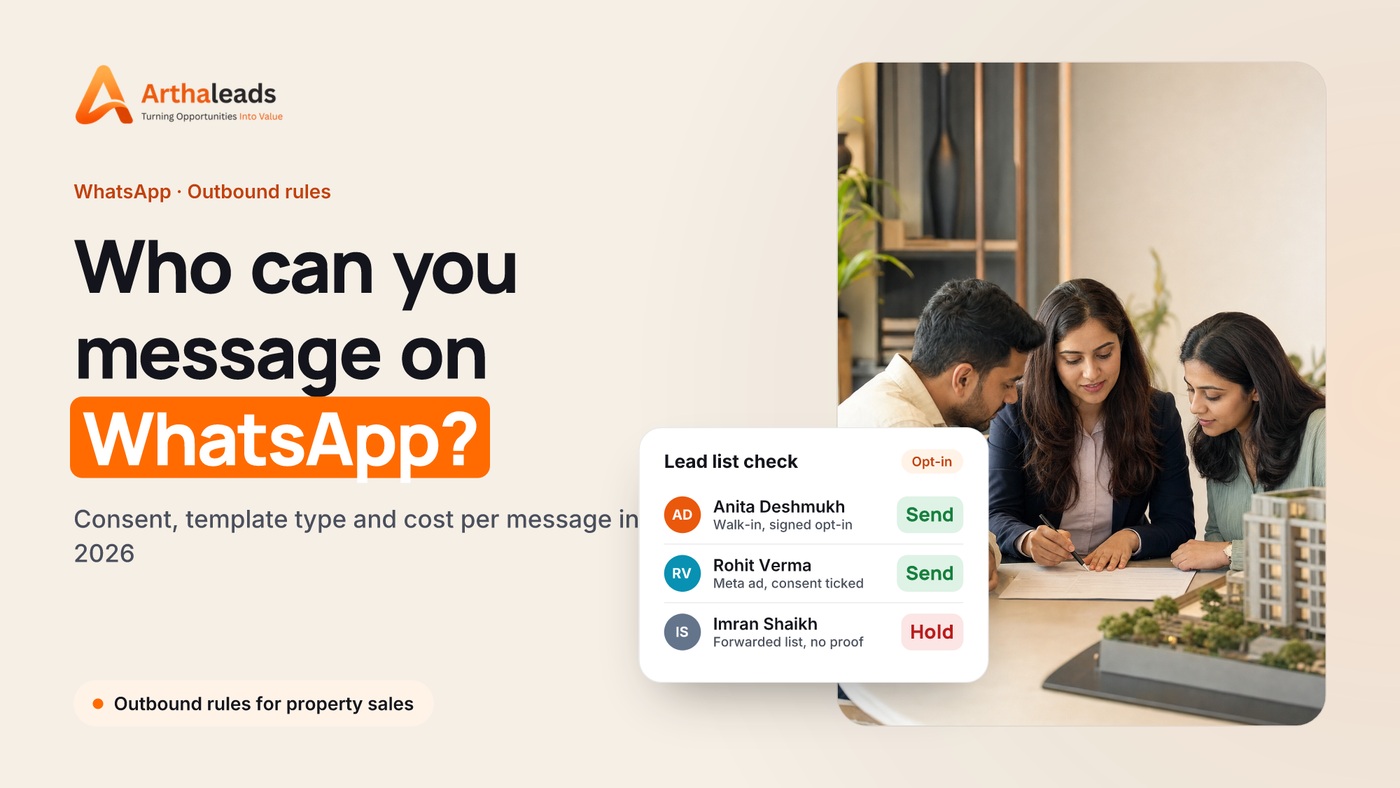
Meta's opt-in guidance says a business must obtain opt-in before messaging people on WhatsApp. You choose the method, but you must be able to show it complies with applicable law, and Meta lists in-person and paper opt-in as supported methods.
In real estate, the same lead database mixes very different levels of consent. This is how we would sort it.
| Lead source | Consent you can usually show | What to do |
|---|---|---|
| Meta lead ad form | A form with a separate WhatsApp tick, saved with the lead | Safe for marketing templates if the tick exists |
| Website form | The same checkbox and wording, stored | Safe if the tick exists |
| Walk-in register | A signed or ticked paper opt-in that names WhatsApp | Safe if you keep the register |
| Portal enquiry (99acres, MagicBricks, Housing.com) | An enquiry about a property, not clearly consent for promotions | Reply to the enquiry, ask for opt-in, hold promotions until then |
| Click-to-WhatsApp ad chat | The buyer messaged you first | Reply in the 24-hour window, then ask for opt-in before campaigns |
| Forwarded channel partner or broker list | None that you can show | Do not message; ask the source for proof or have the leads opt in |
Meta also recommends a separate opt-in for each message category, and clear opt-out instructions that you actually honour. In practice, that means one extra tick on your forms: I agree to receive project updates and offers on WhatsApp.
Portals differ in what their enquiry forms say, so read each portal's terms before treating its leads as opted in. Our advice is simple: the first reply to a portal enquiry should ask for permission to send updates.
Marketing, utility or service: which type each message falls under
According to Infobip's template compliance guide, a template that mixes promotional and transactional content is classified as marketing. A utility template must be non-promotional and tied to something the user did. Utility templates with promotional intent are reclassified as marketing.
Here is how common real estate messages map to those categories.
| Message | Likely category | Why |
|---|---|---|
| Your site visit is confirmed for Saturday, 11 am | Utility | Tied to an action the buyer took, no promotion |
| Reminder with location pin and contact person | Utility | Non-promotional, about a booked visit |
| Booking amount received acknowledgement | Utility | Transactional |
| New launch announcement with an offer | Marketing | Promotional |
| Still looking in Hinjewadi? We have new inventory | Marketing | You start the chat to promote |
| Visit confirmation plus a limited-period offer | Marketing | Mixed content is classified as marketing |
| Answer to a buyer's question within 24 hours of their message | Service | Free-form reply, no template needed |
The practical lesson is to keep confirmations clean. If you add an offer line to a visit reminder, you pay the marketing rate for a message that should have cost far less, and you risk the template being reclassified.
What WhatsApp marketing costs in 2026
Meta's pricing page says that from 1 October 2026 Meta resumes charging for service messages, with a free tier of 1,000 service messages per month per business phone number. Marketing, utility and authentication messages are already charged.
For India, ChatMaxima, MyOperator and a dev.to analysis quote Meta's INR rate card at ₹0.8631 per delivered marketing message and ₹0.1150 for utility and authentication, all before 18% GST. MyOperator reports that the marketing rate rose by about 10% from ₹0.7846. We could not open Meta's INR rate card ourselves, so check the current figures there before budgeting.
| Message type | Rate before GST (secondary sources) | With 18% GST | Cost of 10,000 messages with GST (our arithmetic) |
|---|---|---|---|
| Marketing | ₹0.8631 | about ₹1.0185 | about ₹10,185 |
| Utility | ₹0.1150 | about ₹0.1357 | about ₹1,357 |
| Service, after 1,000 free a month | ₹0.1150 | about ₹0.1357 | about ₹1,221 (first 1,000 free) |
Provider markup is extra
Providers add their own markup. AiSensy's pricing page shows ₹1.09 per marketing message and ₹0.145 per utility or service message, which looks like Meta's rate plus markup. MyOperator gives an example markup of ₹0.10 to ₹0.30 per message, which is ₹1,000 to ₹3,000 on 10,000 messages.
So ask every provider one question: is this price Meta only, Meta plus markup, and with or without GST?
A 10,000-lead example
For example, a developer has 10,000 leads, of which 7,500 have a recorded WhatsApp opt-in and 2,500 do not. These numbers are illustrative.
- Marketing message to all 10,000: 10,000 × ₹0.8631 = ₹8,631, about ₹10,185 with GST, before provider fees.
- Marketing message only to the 7,500 opted-in leads: ₹6,473, about ₹7,638 with GST.
- Same 7,500 at a provider price of ₹1.09: ₹8,175 before GST.
- Visit confirmations (utility) for 1,000 booked visits: 1,000 × ₹0.1150 = ₹115, about ₹136 with GST.
The cheaper option is also the safer one. Sources describe the rate as charged per delivered message, so messages blocked by a cap should not be billed, but confirm that with your provider.
There is one free route. When a buyer messages you from a Click-to-WhatsApp ad and you reply within 24 hours, Meta opens a 72-hour free-entry-point window, and Meta's pricing table says marketing templates are free inside it. Meta is also running a beta feature to cap the price you pay per marketing message, with open beta from October 2026.
Why some messages never arrive
Teams often report that a broadcast reached some leads and not others, and blame the tool. Meta's per-user limits page explains a common reason: WhatsApp may cap how many marketing templates a person receives from any business, based on their engagement, and each delivered marketing template counts towards it.
Undelivered capped messages return error code 131049, and Meta says to wait at least 24 hours before retrying that user. The caps are not active in the EEA, UK, Japan or South Korea, which means they apply in India.
Messaging limits are a separate control. They set how many unique users a business can proactively message in a rolling 24 hours. According to Clickatell's help centre, unverified businesses get 250, and verified businesses start at 1,000 and scale to 10,000, 100,000 and unlimited. We did not open Meta's own page for this, so verify the tiers for your account.
In practice, a 10,000-lead launch list will need to be spread over several days unless your tier is high.
- Send only to leads with a recorded opt-in
- Honour every STOP reply the same day
- Do not repeat the same template to people who never reply
- Space campaigns out, and retry capped users no sooner than 24 hours later
- Check your quality rating after every large send
Rules that touch your broadcasts: RERA, DPDP and DND
RERA number and QR on creatives
According to TaxGuru's report on MahaRERA order 43/2013 (29 May 2023), every project promotion or advertisement published after 1 August 2023 must carry the QR code, registration number and website address. It covers social media, websites, brochures and flyers.
The Realty Today reports a later directive that carries a ₹50,000 penalty, and says the registration number and URL font must be at least as large as the largest contact-detail font. This is Maharashtra only, so check your own state RERA. Whether a WhatsApp broadcast counts as an advertisement is our reading, not a ruling, but the safe course is to treat every brochure or creative you send as one and put the number and QR on the image itself.
DPDP Act and lead data
The government's PIB document says the DPDP Rules were notified on 14 November 2025 with an 18-month phased timeline. Each data fiduciary must give a separate, clear consent notice, and consent can be withdrawn at any time.
One secondary source, consent.in, puts the full obligations at 13 May 2027, so confirm the date with MeitY. Either way, record when, where and for what each lead consented, and make opting out as easy as replying STOP.
Where TRAI and DND stand
As of early 2026, commentators such as Nofeck and ComplyZero say TRAI's DLT and DND regime applies to SMS and voice calls through telecom operators, and that WhatsApp, as an OTT service, is not currently covered directly. We found no TRAI primary source, so treat this as unsettled. Several of those sources still advise building your lists as if DND applied.
For calls, the rules are clearer. Read TRAI Rules for Real Estate Calls: The New 7-Day Enquiry Rule.
A stage-by-stage message plan
Here is a simple plan that matches each stage of a lead to a message type. The frequency advice is our suggestion, not a Meta rule.
New enquiry
Reply inside the 24-hour window as a service message, and ask for WhatsApp opt-in for project updates.
Site visit invite
Send a utility template once the buyer has agreed a day and time. Keep offers out of it.
Day before and day of
Send a utility reminder with the location pin and the name of the person who will meet them.
Post-visit
If the buyer replies, answer in the window as a service message. If they stay silent, send one marketing template with the brochure and the RERA number.
Cold-lead revival
Message only opted-in leads, one marketing template at a time. Our suggestion is no more than one a week, and stop after two or three unanswered messages.
New launch
Send a marketing template to opted-in leads, grouped by location, budget or configuration. Send in batches within your messaging tier.
Here is a sample marketing template for a launch. The placeholders are filled in by your system.
Hi {{1}}, this is {{2}} from {{3}}. Our new tower at {{4}} opens for bookings on {{5}}. Reply YES and we will send the brochure and pricing. RERA No. {{6}}. Reply STOP to opt out.
And here is a sample utility template for a visit confirmation.
Hi {{1}}, your visit to {{2}} is confirmed for {{3}} at {{4}}. {{5}} will meet you at the site office. Call {{6}} if you need directions.
Keep every broadcast tied to a lead record
The usual failure is a campaign run from a separate tool, with replies landing in one person's phone. Nobody knows who opted in, who replied, or who owns the follow-up. Whichever tool sends the template, the lead record should hold the following.
- Opt-in status, with the source and date
- Which template went out, and its category
- Delivery status, including capped or failed messages
- Replies, and the person who owns the next step
- Current stage: enquiry, visit booked, visited, negotiation, booked
Replies to a broadcast are inbound enquiries and need a fast human answer. A CRM such as Arthaleads helps by bringing WhatsApp chats, ad leads and imported portal leads into one place, assigning each lead to a person and reminding them to follow up. See real estate lead management software for how that works.
If you want to see WhatsApp conversations sitting beside the lead record, look at Arthaleads WhatsApp CRM. Plans start at ₹599 per user per month (Starter) and ₹999 (Growth), plus 18% GST, with a 14-day free trial of Growth and no credit card.
Frequently asked questions
Is WhatsApp marketing legal in India, and do I need consent to message property leads?
Meta's policy requires you to get opt-in before messaging someone and to be able to show it complies with applicable law. The DPDP Rules, notified on 14 November 2025, also call for a separate, clear consent notice that the person can withdraw at any time. This is not legal advice, so have your counsel check your forms.
Can I send a WhatsApp broadcast to leads from 99acres, MagicBricks or Housing.com?
A portal enquiry shows interest in a property, but not necessarily consent to promotions on WhatsApp. Reply to the enquiry, ask for permission to send updates, and hold marketing templates until you have it. Check each portal's terms as well.
How much does it cost to send a WhatsApp marketing message in India in 2026?
According to secondary sources quoting Meta's INR rate card, a delivered marketing message is ₹0.8631 before GST, or about ₹1.0185 with 18% GST. Utility messages are ₹0.1150 before GST. Provider markup comes on top, so confirm against Meta's rate card and ask your provider for the all-in price.
Does DND or TRAI apply to WhatsApp messages?
As of early 2026, commentators say TRAI's DLT and DND regime covers SMS and voice calls, and that WhatsApp as an OTT service is not directly covered. We found no TRAI primary source, so it is safer to treat DND-listed numbers with caution anyway. Meta's own opt-in rules apply regardless.
Why are my WhatsApp marketing messages not delivered to some people?
WhatsApp may cap how many marketing templates a person receives from any business, based on their engagement. Messages blocked by this cap return error 131049, and Meta says to wait at least 24 hours before retrying that user. Messaging limits and your quality rating can also affect how many people you can reach.
Can I get my number banned for sending too many broadcasts to property leads?
Meta advises monitoring your quality rating, and sending to people who did not opt in or ignoring opt-outs puts that rating at risk. Meta's policy pages describe the controls, but we have no figures on when a block happens. The safest approach is to message only opted-in leads and keep frequency low.
About Arthaleads
Arthaleads is a CRM for Indian real estate sales teams. It brings enquiries from ads, portals, your website and WhatsApp into one workspace, with follow-ups, projects, bookings and invoices. These articles are educational and are not a substitute for advice based on your own business and data.