
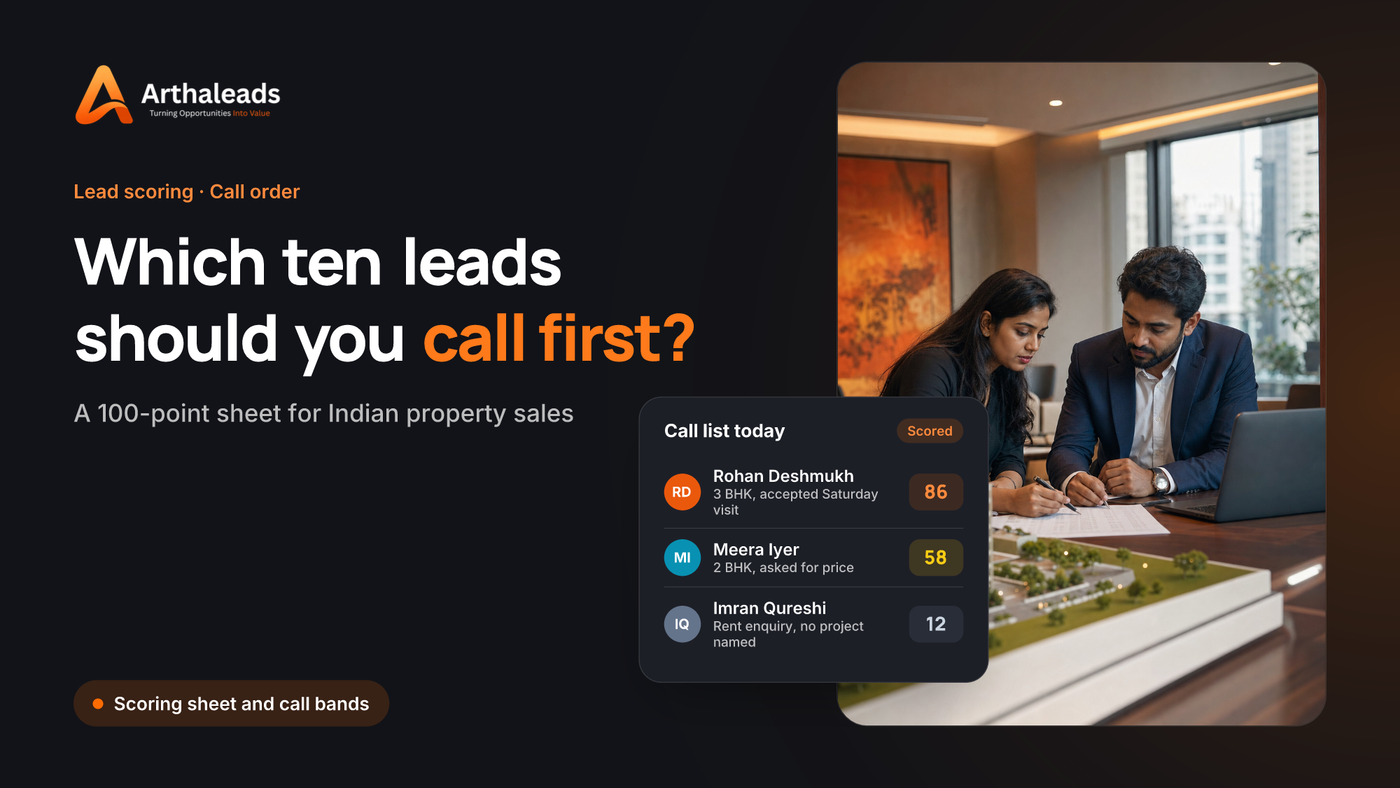
Your telecallers open the CRM on Monday and find 400 open enquiries, and nobody can say which ten to call first. So they call in arrival order, or whoever shouted loudest in the team group, and the buyer who was ready to visit this weekend waits behind a rent enquiry. Real estate lead scoring fixes this by giving every enquiry a number, so the call list is ranked by how likely each person is to visit and buy.
You do not need a data science team for this. This article gives you a 100-point sheet you can copy into a spreadsheet today, with score bands that map to a call deadline and an owner.
We also cover what AI scoring adds, how much history it needs before you trust it, and how to check that your scores predict site visits. We do not quote conversion uplift numbers, because most of the ones in circulation come from vendor marketing.
Why the order of the call list matters more than the size of the lead list
Sell.Do's guide to real estate lead generation puts it plainly: when presales has 400 open leads, the order of the call list is worth more than the size of it (source). Sell.Do is a CRM vendor, but the point holds for any team. After the first week of a campaign, the problem is rarely too few leads. It is deciding who gets the next call.
For example, if a telecaller makes 40 calls a day and 400 enquiries are open, a call list in arrival order means a serious buyer can wait ten days behind people who were never going to visit. Choosing by gut feel is not much better, because it favours the enquiries a telecaller happens to remember.
This article covers only the ranking step. For the full path from enquiry to visit, read Real Estate Lead Management: From First Enquiry to Site Visit in 5 Steps.
What real estate lead scoring is (and what it is not)
Lead scoring gives each enquiry a number, usually 0 to 100, based on how well the person fits what you sell and how they behave after enquiring. A higher number means call sooner. Three groups of signals do most of the work:
- Fit: does their budget match inventory you actually have, do they want a configuration and location you sell, and is their timeline close?
- Behaviour: did they pick up, reply on WhatsApp, ask for price, accept a site visit slot, or attend one?
- Source: how reliably does this channel produce buyers for your project?
Scoring is not a verdict on the buyer. It is a queue order. A low score means call later or nurture on WhatsApp, not never.
It also does not replace the first conversation. Several of the best signals, such as budget, timeline and purpose, only come from asking.
A 100-point scoring sheet for property enquiries
Here is a starting sheet: fit 40 points, behaviour 40, source 20, minus penalties. These weights are our suggested starting point, not an industry benchmark. Change them after a month of your own data.
Fit and behaviour (80 points)
| Group | Signal | Points |
|---|---|---|
| Fit | Budget covers a unit you have in stock | 15 (7 for a small stretch, 0 if not) |
| Fit | Configuration matches what you sell | 8 |
| Fit | Location or project preference matches | 7 |
| Fit | Purpose is clear (own use or a defined plan) | 5 |
| Fit | Wants to buy within about three months | 5 |
| Behaviour | Picked up a call or replied on WhatsApp within a day | 10 |
| Behaviour | Asked for price, payment plan or floor plan | 8 |
| Behaviour | Accepted a specific site visit slot | 12 |
| Behaviour | Attended a visit earlier | 10 |
Source quality (20 points)
| Source | Points |
|---|---|
| Referral or past customer | 20 |
| Walk-in or site QR scan | 16 |
| Portal enquiry that names your project | 12 |
| Meta or Google lead form | 8 |
| Broad campaign enquiry with no project named | 5 |
Set source points from your own experience of each channel, and revisit them every quarter. Then apply penalties:
- Not a buyer (rent, PG, job or service enquiry): minus 40. Sell.Do's lead generation guide claims such searches can absorb 20 to 30% of an unmanaged Google search budget. That is a vendor claim, but you will see these leads in your own data.
- Two unanswered attempts on different days: minus 5 each time.
- Missed a confirmed site visit without a callback: minus 10.
- Wrong number or asked to stop calls: remove from the call list.
Most fit points come from three questions on the first call: budget range, configuration, and when they want to move. Make those mandatory fields, so the score can actually be filled in.
Turning scores into action: Hot, Warm and Nurture bands
A score changes nothing unless it changes what happens next. Map each band to an action, a deadline and an owner.
| Band | Score | Action | Deadline | Owner |
|---|---|---|---|---|
| Hot | 70 to 100 | Call, offer two visit slots, confirm on WhatsApp | Within 15 minutes in working hours | Best closer or senior telecaller |
| Warm | 40 to 69 | Call, confirm budget and timeline, send project details | Same day | Assigned telecaller |
| Nurture | 0 to 39 | WhatsApp sequence and one call attempt | Within 2 days, reviewed weekly | Presales team |
Two owner rules help. First, a Hot lead should never sit in the queue of a telecaller who is on leave, so reassign it if the deadline is missed. Second, leads move up a band the moment they behave: a Nurture lead who replies asking for the price should be re-scored and called the same day.
Follow-up cadence inside each band is a separate topic, covered in A Real Estate Follow-Up System Your Sales Team Will Actually Use. For booking and confirming the visits that Hot leads produce, see Site Visit Management.
Mistakes that make scoring useless
- Stale scores. A score set on day one and never updated ranks yesterday's behaviour. Re-score after every call, reply, visit or missed visit.
- No-show blindness. GrowthSparx, relaying a May 2026 Pitch report that quotes ANAROCK, puts site visit no-show rates at 30 to 45% (source). Check the original before you quote it, but the lesson stands: an accepted slot is not an attended visit. Give points for attending and subtract for missing.
- Writing off buyers who must sell an existing flat first. HelloGrowthCRM treats this signal as a slower lead to route to nurture, not a dead lead (source). Tag it, cap the lead at Warm, and review it monthly.
- Scoring on source alone. A portal lead who never answers is worth less than a Meta lead who replies in minutes and asks for the floor plan. That is why source is only 20 points of 100.
If your telecallers say the scores feel wrong, believe them. Check which signal is missing before you touch the weights.
Where AI lead scoring beats a spreadsheet, and what it needs first
A spreadsheet sheet is static. You set the weights once, and someone must update every row by hand. AI lead scoring in a real estate CRM re-scores as signals arrive, such as replies, call outcomes and visit status, and can learn which signals predict visits in your own projects.
It is not magic, and it needs history. Realatic separates static rule scoring (for example, plus 10 if the budget is above ₹1 crore) from AI scoring, and says accuracy improves after 60 to 90 days of closed and lost deal data (source). HelloGrowthCRM is blunter: an account with about 50 leads and no recorded outcomes gets a number barely better than a guess, and the ordering usually becomes useful after about a quarter of activity.
So start with the sheet above, and switch on AI once you have these in place:
- Every lead has a source recorded at capture
- Call outcomes are logged after every call
- Site visits are marked attended or no-show
- Bookings and lost reasons are recorded
- Duplicate enquiries are merged into one record
Why a score without a reason won't be trusted
A telecaller who sees 82 next to a name with no explanation will ignore it within a week. A reason changes that, for example: asked for 3 BHK price, accepted Saturday slot, budget fits current stock. It also tells the caller what to say. Arthaleads' AI lead scoring shows the reason behind each score, which is the feature to test in any tool you trial.
Lead data caution: keep scoring inside your CRM
Scoring uses personal data: names, phone numbers, budgets and how someone behaved. Treat it with care, even if your team is small. This is not legal advice, so ask your lawyer how India's DPDP Act applies to your lead handling, including internal scoring.
- Keep scoring inside your CRM, not in spreadsheets forwarded on WhatsApp groups or saved on personal phones.
- Collect only what scoring needs: budget range, configuration, timeline and purpose.
- Tell people how their data is used, in the form text or the first message: that you will contact them about the project and may rank enquiries to reply sooner.
- Limit access by role, and remove access when someone leaves the team.
- Do not paste lead lists into public AI tools to score them.
How to check the scoring is working: lead-to-site-visit by band
The test of a score is whether higher bands visit more. Sthan reports that there is no credible, current, India-wide public figure for site-visit-to-booking conversion, that most confident percentages trace back to vendor marketing, and that conversion rate is defined differently everywhere (source). So measure your own.
Tag the band
Record the band at the first call, so later re-scoring does not rewrite history.
Count by band
Each month, list leads, connected calls, visits booked, visits attended and bookings for Hot, Warm and Nurture.
Compare lead-to-site-visit
Hot should beat Warm, and Warm should beat Nurture. If not, a weight is wrong, often source or budget fit.
Adjust one thing at a time
Change one weight, run a month, and compare again.
Cost shows why this matters. GrowthSparx works through an example: at ₹800 cost per lead and one visit for every eight leads, a visit costs ₹6,400 before no-shows (source). Better ranking spends the same lead budget on the people likelier to visit.
Arthaleads is real estate CRM software for builders, developers, channel partners and brokers in India. It brings enquiries from Meta lead ads, WhatsApp, website forms and imported portal files into one place, with AI lead scoring and follow-up reminders. There is a 14-day free trial of Growth with no credit card, if you want to compare it against your own spreadsheet.
Frequently asked questions
How does lead scoring work for a property enquiry?
Each enquiry earns points for fit (budget, configuration, location, purpose, timeline), behaviour (replying, asking for price, accepting and attending a visit) and source, minus penalties for signs such as not being a buyer. The total decides the band and the call deadline. Re-score after every call or reply.
How long before AI lead scores are worth trusting?
It depends on your history. HelloGrowthCRM says the ordering usually becomes useful after about a quarter of activity, and Realatic says accuracy improves after 60 to 90 days of closed and lost deal data. That assumes outcomes and site visits are logged cleanly. Until then, use the points sheet.
What is the difference between rule-based and AI lead scoring?
Rule-based scoring uses fixed points you set, such as plus 10 for a budget above a threshold. AI scoring learns from your own closed and lost deals and updates as signals change. Rules are transparent from day one, while AI needs outcome history and should show the reason behind each score.
Can a small team of 5 to 10 telecallers use lead scoring without a CRM?
Yes. A spreadsheet with a column for each signal, a total and a band works at small volumes. The weak point is discipline, because someone must re-score rows after every call. Move to a CRM when those updates start slipping.
Should I stop calling low-score leads?
No. Move them to the Nurture band, with a WhatsApp sequence, a call attempt within two days and a weekly review. Remove only wrong numbers, people who asked to stop, and clear non-buyers.
Does lead scoring work with portal leads and Meta leads together?
Yes, and the source points exist for exactly this. Both go through the same sheet, so a portal lead and a Meta lead compete on fit and behaviour, with source adding a small difference. Reply quickly to both, whatever the score.
About Arthaleads
Arthaleads is a CRM for Indian real estate sales teams. It brings enquiries from ads, portals, your website and WhatsApp into one workspace, with follow-ups, projects, bookings and invoices. These articles are educational and are not a substitute for advice based on your own business and data.