
It's Sunday evening, a Meta lead came in at 11 pm on Friday, and nobody has replied yet. That gap is where the conversation about AI in real estate should start, because it's the one place where the software plainly earns its keep for a builder or broker.
On the seller's side, AI in real estate means software doing the repetitive selling work (replying, asking first questions, ranking leads, drafting messages, summarising calls) so your people spend their time on conversations that need a person. It isn't a robot salesperson. Most of what ranks online is about valuation and virtual tours, which is buyer-side material and no use to a sales head.
Eight jobs make up the useful part. Each one has a limit, and the limits matter more than the feature lists.
What does AI in real estate sales mean for a builder or broker?
For a builder or broker, AI in real estate sales means software that takes over first replies, routine questions, lead ranking, message drafts and call notes. It sits inside your enquiry flow, not beside your price list. Think of it as a very fast junior who never sleeps but must never be allowed to promise anything.
Business Standard reported in August 2026 that proptech firms are using AI for sales calls and for WhatsApp assistants that answer queries and schedule site visits. The same report says human trust remains essential. I'd read that second half twice, because a buyer paying a token amount is trusting a person, not a model.
| Job | What AI does | Who takes over |
|---|---|---|
| First reply | Answers on WhatsApp, day and night | Telecaller, once the buyer is serious |
| Qualification | Asks budget, timeline and purpose | Telecaller, on the call |
| Scoring | Ranks leads and shows a reason | Manager sets the cutoffs |
| Follow-ups | Drafts messages in the buyer's language | Agent reads and sends |
| Call review | Transcribes and summarises calls | Manager coaches |
| Site visits | Drafts confirmations and no-show messages | Sales executive runs the visit |
| Manager questions | Answers pipeline questions in plain words | Manager decides |
| Copy | Drafts ad and brochure text | Someone checks it against RERA |
How can AI reply to and qualify enquiries on WhatsApp?
A WhatsApp AI agent can greet every enquiry within a minute or two, answer basic project questions from material you've approved, and ask the first qualifying questions: budget, timeline and purpose. It works at 2 am and on Sundays. A human should take over the moment the buyer asks for a discount, a negotiation or a specific unit.
Use 1: reply in minutes, day and night
Say your team gets 300 leads in March and a good share land after 9 pm. Those buyers wait for the morning call, and some have already messaged two other projects. Meta itself launched Business AI inside the WhatsApp Business app in India in May 2026, and its newsroom post says it answers customers around the clock for eligible small businesses. Afaqs adds that it handles native Indian languages, can capture leads and book appointments, and lets the owner take over a chat.
Arthaleads has its own WhatsApp AI agent (on the Growth and Enterprise plans) that replies in English, Hinglish, Hindi and Marathi, and your team can take over any chat. Whichever tool you use, give it a locked fact sheet: project name, configurations, RERA number, possession date as registered. For anything else it should say a colleague will confirm. The tool's limits get their own post: what a WhatsApp AI agent can and cannot do.
Use 2: ask the first qualifying questions
Three questions are enough: budget range, when they want to move, and whether it's for self-use or investment. Don't let the agent interrogate. If the buyer skips a question, let it go and pass the chat to a person.
- Treat 'budget flexible' as unanswered, not as qualified.
- Have the agent summarise the answers in one line for the telecaller.
- Set a rule for when it hands over: a visit request, a price question, or any complaint.
How does AI help telecallers pick who to call and what to say?
AI can rank your leads so a telecaller with 120 calls a day starts with the likeliest buyers, draft follow-ups in the buyer's own language, and turn call recordings into transcripts and short summaries. All three jobs save the same thing: the telecaller's attention. None of them makes the call.
Use 3: score leads and show the reason
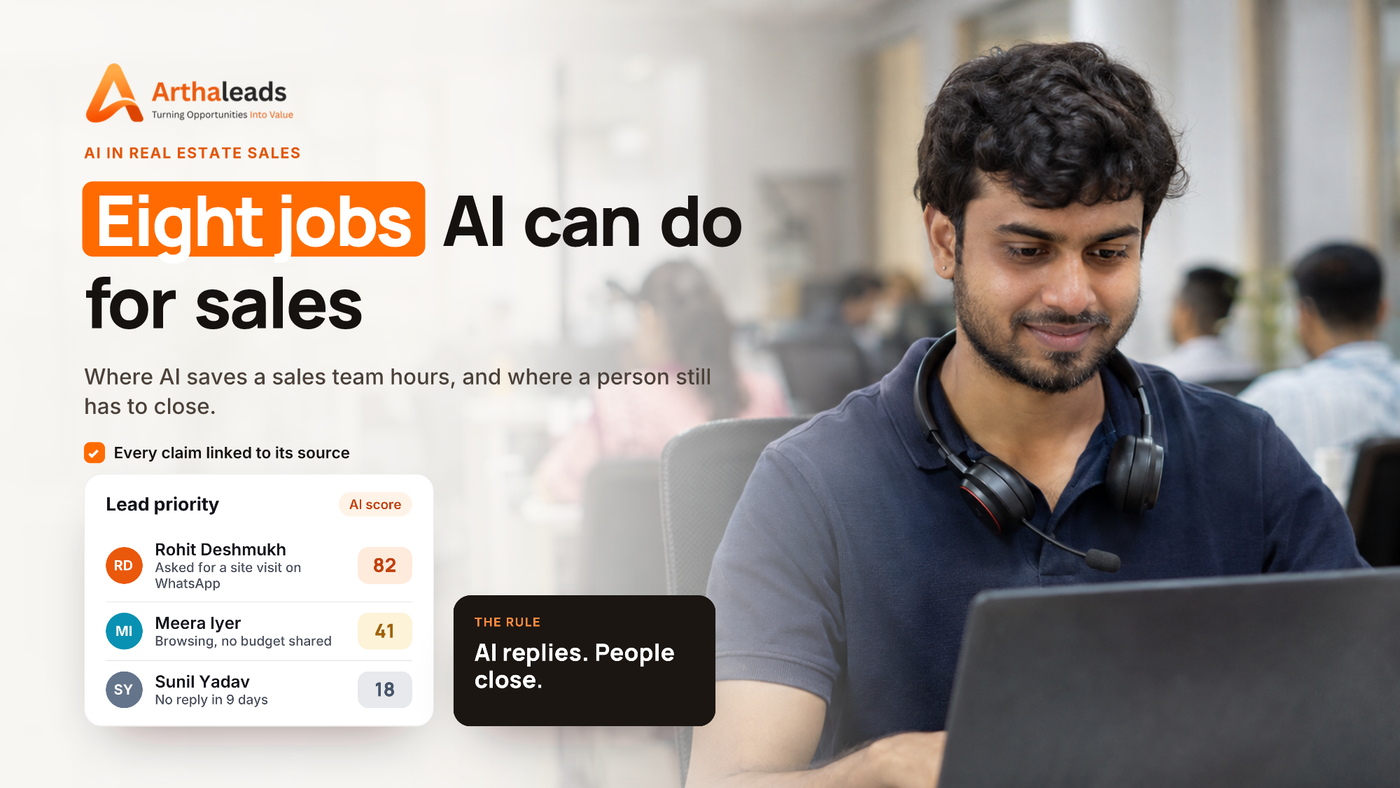
A score without a reason is just a number your team will learn to ignore. If a lead shows 82, the screen should say why: asked for a visit, shared a budget, replied within an hour. Check the reasons against ten leads you know well before you trust the rest. That reason line is what to look for in any tool; in Arthaleads every score shows it next to the lead.
Use 4: draft follow-ups in the buyer's language
Buyers in Pune write 'site visit kab ho sakta hai?' on WhatsApp, not formal English. AI drafts well in Hinglish, Hindi and Marathi, but have a native speaker read the first few batches. A wrong word for 'booking' or 'possession' costs more than ten seconds of checking. And cap the cadence, or the same nudge goes to 400 people three days running.
Use 5: turn calls into transcripts and coaching notes
No manager can listen to every call. A transcript with a summary lets them scan ten calls in the time one recording takes to play, so pull the ones with objections and coach on those. Don't use it to catch people out, or they'll stop logging calls. Tell buyers when calls are recorded.
Where does AI help with site visits, manager reports and ad copy?
Three smaller jobs are worth trying: confirming site visits and chasing no-shows, letting managers ask pipeline questions in plain language, and drafting ad or brochure copy. For the first and last, a general AI tool next to your CRM is enough. The manager questions are only as good as the data your team logs.
Use 6: confirm site visits and win back no-shows
The visit confirmation is the most valuable message you send. Draft a reminder the evening before and a morning note with the location pin and the executive's name. For a no-show, a polite reschedule message the same day beats three cold calls. I'm describing a general AI tool here, with your CRM holding the visit list.
Use 7: let managers ask instead of building reports
In any demo, ask the copilot: 'which Meta leads have had no call in five days?' If it answers from real data and shows the list, it's useful. If it returns a vague summary, skip it. And if your team doesn't log calls, no copilot can fix that.
Use 8: draft ad, listing and brochure copy
A general AI tool will give you ten headlines in a minute, and it will also add 'ready to move', 'best in class' and amenities your project doesn't have. Anything on possession date, carpet area, approvals or amenities must match your project's RERA registration. Strip the rest.
What can AI not do yet?
AI can't negotiate, can't build the trust that gets a family to pay a token amount, shouldn't quote prices or discounts, and shouldn't make unsupervised outbound voice calls to buyers. Those are limits of the job, not only of today's software. Plan your handoffs around them.
- Negotiation: discounts, payment plans and 'best price' belong to someone with authority.
- Price and availability: the agent knows only what you feed it, and units move fast on a launch weekend. Keep it off live inventory unless it reads your stock sheet.
- Trust: the buyer's parents, the spouse and the broker WhatsApp group all weigh in, and they want a person.
- Outbound voice calls: a model dialling thousands of numbers raises consent and DND problems, so keep people on the phone.
Which rules should you check before switching AI on?
Check three things: WhatsApp's policy on AI chatbots, consent for the buyer data you feed into any AI tool under the DPDP Act, and the rules on calls and DND. A property-specific agent answering your own buyers looks like the allowed kind on WhatsApp, but read the terms yourself before you rely on that.
According to respond.io's summary of the WhatsApp Business Solution Terms, since 15 January 2026 'AI Providers' can't offer general-purpose AI assistants as the main function on the Business Platform. Chatbots for a business's own customer service aren't banned. That's a third-party reading, so confirm it on WhatsApp's legal pages.
Buyers gave their number to ask about a flat, not to feed someone's model. Say on your forms that automated tools may handle their messages, ask your vendor where chat data sits and whether it trains models, and give buyers a way to opt out. Our DPDP checklist covers the consent side, and this isn't legal advice, so take your lawyer's view for your firm. On calls, software doesn't change who's responsible if a promotional message or call reaches a DND number.
What does AI cost to run?
AI costs you two things: the CRM's per-seat price and WhatsApp's per-message charges. Arthaleads lists Starter at ₹599 and Growth at ₹999 per user per month plus 18% GST, with a five-seat minimum, as of November 2026. The WhatsApp AI agent sits on Growth and Enterprise. Message charges are separate and set by Meta.
According to this WhatsApp pricing breakdown, Meta's India rate card effective 1 July 2026 charges ₹0.8631 per marketing message and ₹0.1150 per utility message, before GST. Rules on free service conversations have shifted more than once, so confirm on Meta's pricing page how replies inside the service window are billed.
| Item | Rate | Example for a 10-person team |
|---|---|---|
| Growth seats | ₹999 per user plus 18% GST | ₹9,990 plus ₹1,798 GST = ₹11,788 |
| Marketing templates | ₹0.8631 each before GST | 300 sent = about ₹259 before GST |
| Utility templates | ₹0.1150 each before GST | 300 sent = about ₹35 before GST |
Say a 10-person team on Growth sends one marketing template to each of 300 new leads in a month. Seats come to ₹11,788 with GST and the templates to about ₹306 with GST, roughly ₹12,094 in all. Annual billing gives two months free, so 10 seats for a year work out to ten months' price: ₹99,900 before GST. The seat price is the number that matters; messages are small change until you broadcast to your whole database.
A 14-day test for AI in your CRM
Test AI on your own leads for 14 days, not on the vendor's demo data. Load real enquiries, switch on one job at a time, and judge each against one plain question: did it save a person minutes without saying anything wrong? A test that ends with a clear yes or no on each job beats a long feature comparison.
Days 1 to 2
Load about 200 real leads from the last two months, dead ones included, and write a one-page fact sheet for the agent.
Days 3 to 5
Switch on the WhatsApp agent for one project only. Read every chat at night and log each wrong or invented answer.
Days 6 to 8
Check scores on 20 leads you know well. Do the reasons make sense?
Days 9 to 11
Have a Hinglish or Marathi speaker read the follow-up drafts before anything goes out.
Days 12 to 14
Count after-hours replies, handoffs to humans, wrong answers and telecaller time saved. Then decide.
- The agent never quoted a price or confirmed a unit missing from the fact sheet
- A person could take over any chat in one tap
- Every score came with a reason that made sense
- Hinglish and Marathi drafts read naturally to a native speaker
- You can export or delete a buyer's data on request
More on running a trial properly: what to test in a real estate CRM free trial. If you'd like to run this test on Arthaleads, the AI features are on the AI CRM page, and Growth comes with a 14-day free trial, no credit card.
Frequently asked questions
Can an AI chatbot reply to property enquiries on WhatsApp in Hindi, Hinglish or Marathi?
Yes, some can. Afaqs reports that Meta's Business AI works in native Indian languages, and Arthaleads' agent replies in English, Hinglish, Hindi and Marathi. Whatever you use, have a native speaker read the first batches of replies before you trust the tone and the terms.
Is it allowed to run an AI chatbot on WhatsApp Business after Meta's 2026 policy change?
Reports on the January 2026 terms say the ban targets AI providers offering general-purpose assistants as their main function. A chatbot that answers your own buyers about your own projects is described as not banned. Read the Business Solution Terms yourself before you rely on that.
Can AI replace telecallers or channel partners?
It takes over first replies and routine chasing, not negotiation or trust. Your telecallers get more time for buyers who are ready to talk. Channel partners bring buyers and relationships that a chat agent can't.
How accurate is AI lead scoring, and can I see why a lead got its score?
Accuracy depends on your data, so test it on leads whose outcome you already know. Ask the vendor to show the reason behind each score, such as a visit request or a shared budget. If a tool can't explain a score, don't let it decide who gets called first.
Do I need buyer consent before feeding enquiries into an AI tool?
Buyer data is personal data under the DPDP Act, so tell buyers how it's handled and get consent where it's needed. Ask your vendor where chats are stored and whether they train models. Take your lawyer's view for your firm's setup.
About Arthaleads
Arthaleads is a CRM for Indian real estate sales teams. It brings enquiries from ads, portals, your website and WhatsApp into one workspace, with follow-ups, projects, bookings and invoices. These articles are educational and are not a substitute for advice based on your own business and data.