
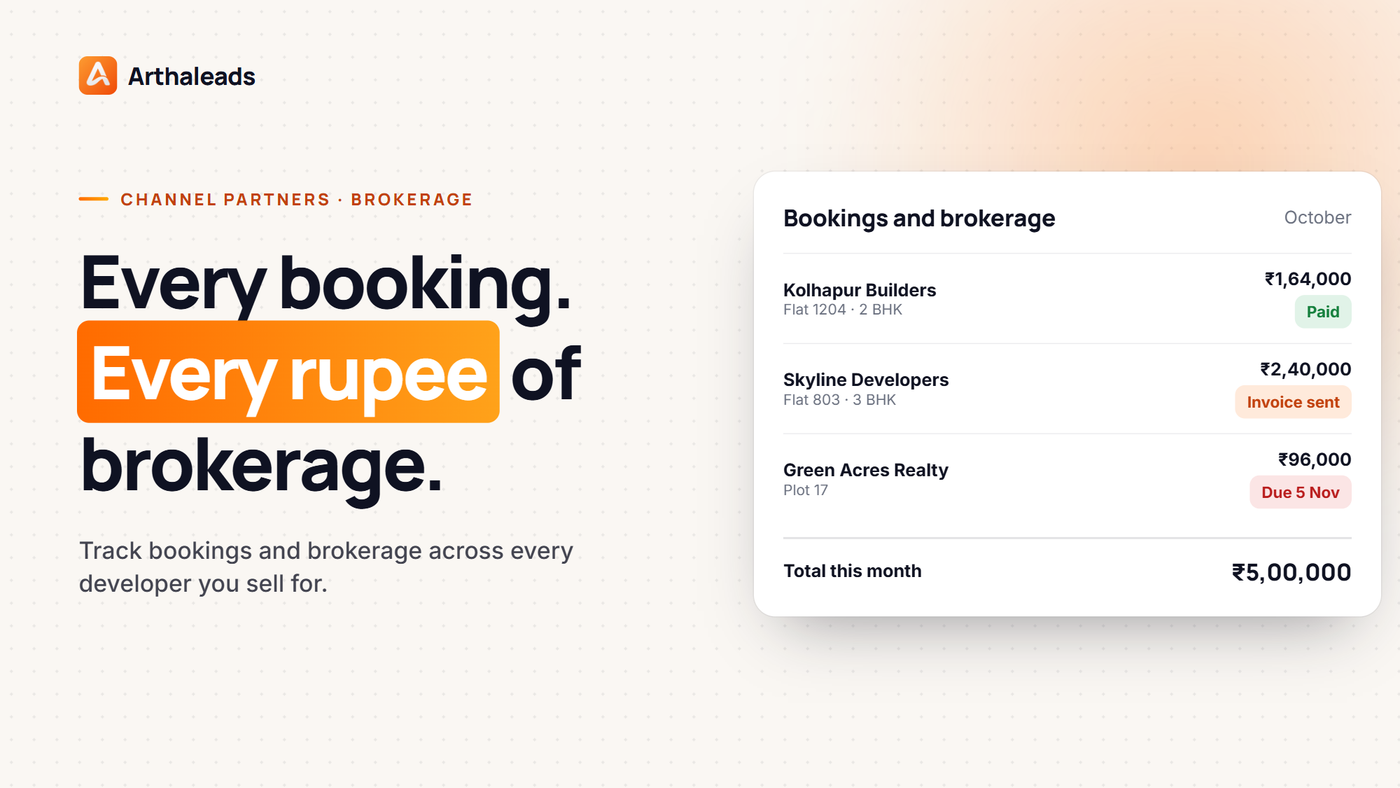
Channel partners in Indian real estate rarely sell for just one builder. A typical brokerage firm might have three projects from one developer in Hinjewadi, a plotted scheme from another on the highway, and a luxury tower from a third in the city. Each developer has its own brokerage percentage, its own rules for registering a client, its own paperwork for raising an invoice, and its own speed of paying. Keeping all of that straight in a notebook and a WhatsApp group is how brokerage gets missed.
This guide is for brokers and channel partners who work across several developers. It covers how to organise developers and terms, how to protect lead ownership, how to track bookings, how to raise invoices with GST, how to follow up on unpaid brokerage, and why RERA agent registration matters.
Why channel partners lose track across developers
When you sell for one developer, the rules are easy to remember. When you sell for five, they blur. Was the brokerage on that project 2% or 2.5%? Does it apply on the agreement value or the basic sale price? Is it paid after the agreement is registered, or after a percentage of payment is received? Which client did you register with which developer, and on what date?
None of these questions is hard on its own. The difficulty is that the answers live in emails, signed agreements, and the memory of whoever handled that developer. When a salesperson leaves, the memory leaves with them. A simple system for channel partners has to answer three things at any moment: which developers you work with and on what terms, which clients you have introduced to whom, and which bookings are waiting for payment.
Keep each developer's projects and brokerage terms straight
Start with a developer list, not a lead list. For every developer you sell for, record:
- The legal name and billing details you will put on invoices, including their GSTIN.
- The projects you are authorised to sell, with each project's RERA registration number.
- The brokerage percentage and what it is calculated on, as written in your agreement.
- The payment trigger: what has to happen before brokerage becomes payable.
- The registration rule: how a client must be registered with them, and how long that registration stays valid.
- The contact person for registrations and the one for payments, who are often different people.
Keep a copy of the signed channel partner agreement with each developer, and update the list whenever terms change for a new phase or a new project.
In ArthaLeads, the developer partners list does this job for the commercial side. You keep a list of developers you sell for, each with a default brokerage percentage, and that percentage fills in automatically on new bookings for that developer. Projects are managed separately, so your team can work leads, brochures and floor plans for several projects at once.
Lead ownership and registration disputes
The most painful argument between channel partners and developers is about who brought the client. A buyer you introduced visits the site again on their own, or comes back through another broker, and suddenly your brokerage is in question.
You cannot remove this risk completely, but you can reduce it. This is general practical advice, not legal advice:
- Register the client with the developer before the first site visit, using whatever method your agreement specifies.
- Get the registration acknowledged in writing. An email reply or a written confirmation from the developer's team is far stronger than a phone call or a verbal "yes, noted".
- Record the date, the project and the client's details exactly as registered, and keep the acknowledgement with the lead.
- Attend the site visit or make sure your name is recorded on the visit form at the sales office.
- Know the validity period. Many agreements limit how long a registration protects you. Follow up before it lapses.
If a dispute does arise, a clear trail of dated, written acknowledgements is what you will rely on. If the amount at stake is significant, speak to a lawyer who can read your actual agreement.
Tracking bookings from closed deal to payment
A booking is where the money starts, but it is also where tracking usually stops. The client signs, everyone celebrates, and three months later nobody is sure whether the agreement was registered, whether the payment trigger was met, or whether an invoice was ever sent.
Treat every booking as a small project with its own stages:
- Booked: the client has paid the booking amount. Note the unit, the agreement value and the developer.
- Agreement registered: record the date.
- Brokerage due: the trigger in your agreement has been met.
- Invoice raised: record the invoice number and date.
- Paid: record the amount received and the date, and check it against the invoice.
ArthaLeads has a booking and invoice engine built for this. When a deal closes, you turn it into a booking in one click. The brokerage is calculated from the developer's default percentage, and each invoice carries a number and a status, so you can see at a glance which bookings are invoiced and which are paid.
Raising brokerage invoices with the correct GST
Brokerage is a service, so your invoices usually need to show GST correctly. In general terms, if you and the developer are registered in the same state, the tax is split into CGST and SGST, and if you are in different states, IGST applies instead. Your invoice should show your GSTIN, the developer's GSTIN, the taxable value, the tax breakup and an invoice number in sequence.
The rules on rates, registration thresholds, invoice contents and filing can change, and they depend on your specific situation. Use the official sources: the CBIC GST website has GST rates and FAQs, and the GST portal handles registration and returns. Always confirm the treatment for your firm with your CA before you change how you invoice.
A good invoice also speeds up payment. Developers' accounts teams often hold an invoice that has the wrong legal name, a missing RERA number or no bank details. In ArthaLeads, the invoice engine calculates CGST, SGST or IGST and produces a branded PDF invoice with your logo, RERA number and bank details, which removes most of those reasons for delay.
Following up on unpaid brokerage
Unpaid brokerage is common for channel partners, and most of it is not bad faith. Invoices get stuck between the sales team and the accounts team, or wait for a signature that nobody is chasing. A steady, polite routine works better than an angry call after six months.
- Review all unpaid invoices every week, sorted by how long they have been outstanding.
- Confirm receipt within a few days of sending. Ask the developer's accounts contact to confirm the invoice is in their system.
- Follow up on a fixed rhythm, for example at 15, 30 and 45 days, by email so there is a written trail.
- Escalate calmly to your sales contact at the developer if accounts does not respond. They want to keep good channel partners happy.
- Keep a record of every follow-up against the invoice, so whoever picks it up next knows the history.
Set a follow-up reminder against each unpaid invoice, the same way you would for a buyer. Our guide to building a real estate follow-up system applies just as well to collecting brokerage as it does to closing buyers.
RERA agent registration
Under the Real Estate (Regulation and Development) Act, real estate agents who facilitate the sale of units in registered projects generally need to register with the regulatory authority of the state they operate in. Each state runs its own RERA authority and portal. In Maharashtra, for example, the MahaRERA website has a section for real estate agents covering training, registration and renewal, along with a public search of registered agents.
Keep your registration current, show your RERA agent number on your invoices and marketing, and check the rules on your state's official RERA site, since requirements differ between states. Developers increasingly ask channel partners for a valid registration before signing an agreement.
A weekly routine that keeps it all current
None of this works unless someone keeps the records up to date. For most firms, a short routine through the week is enough:
- Monday: check client registrations that are close to expiring, and renew or follow up before they lapse.
- Midweek: update the stage of every open booking, and note any sale agreement registered in the last few days.
- Thursday: raise invoices for every booking whose brokerage trigger has been met, and send them to the right accounts contact.
- Friday: review unpaid invoices by age and send the follow-ups that are due that week.
The days are only a suggestion; what matters is that each check happens every week. A few minutes of record keeping each day is far less work than weeks spent proving a claim you could not document.
Bringing it together
Channel partners who get paid on time usually do the same few things: a clear developer list with terms, written registration for every client, a booking tracked through to payment, correct GST invoices, and a weekly look at what is unpaid. None of it is complicated. It just has to live in one place rather than in several notebooks.
To see how this fits with the rest of your sales work, browse all features, compare plans on our pricing page, or read how to manage leads from first enquiry to site visit. When you are ready, start a 14-day free trial.
Frequently asked questions
How do channel partners track brokerage across several developers?
Keep one list of developers with each agreement's brokerage rate, payment trigger and registration rule, and treat every booking as a record that moves through stages: booked, agreement registered, brokerage due, invoice raised and paid. A weekly review of unpaid invoices catches the ones that stall.
When does a channel partner get paid brokerage?
It depends on the agreement with each developer. Common triggers include the buyer paying a set share of the agreement value, or the sale agreement being registered. Record the exact trigger for every developer, because that is the point at which you can raise your invoice.
How can a channel partner prove they brought the client?
Register the client with the developer before the first site visit, get the registration acknowledged in writing, and make sure your name is on the visit form at the sales office. Dated, written acknowledgements are what you will rely on if there is ever a dispute.
Do channel partners need RERA registration?
Generally, yes. Under RERA, real estate agents who facilitate sales in registered projects must register with their state's RERA authority, and many developers ask for the number before signing a channel partner agreement. Check your state's rules and keep the registration current.
Do brokerage invoices need GST?
Usually, if you are registered for GST, because brokerage is a taxable service. The correct treatment depends on your registration and the developer's location, so confirm it with your chartered accountant before you set up your invoice format.
About Arthaleads
Arthaleads is a CRM for Indian real estate sales teams. It brings enquiries from ads, portals, your website and WhatsApp into one workspace, with follow-ups, projects, bookings and invoices. These articles are educational and are not a substitute for advice based on your own business and data.