

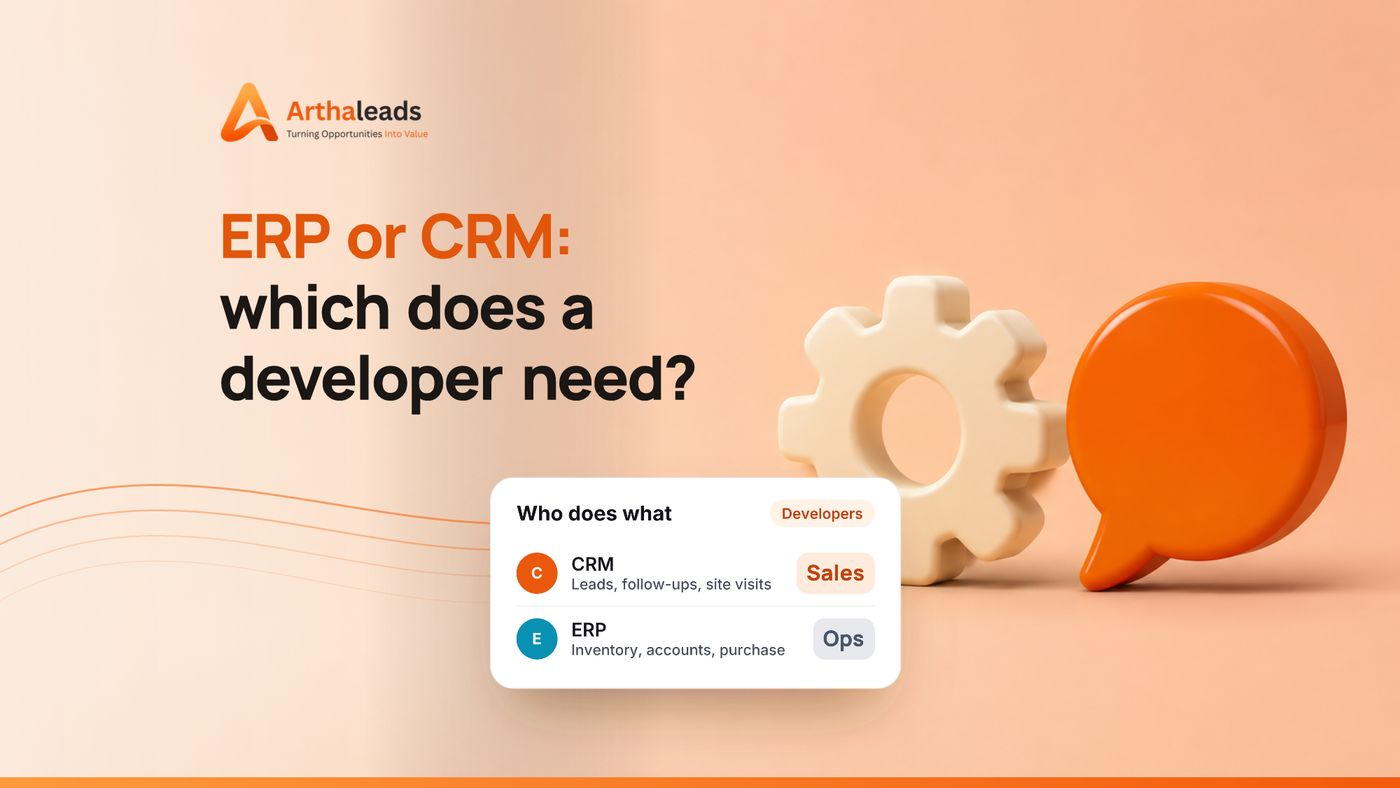
Your sales team replies to enquiries on WhatsApp and notes site visits in a notebook, while the accounts team works in a heavy system nobody on the sales floor opens. Then the MD asks: we are buying a real estate ERP that has a CRM module, so why a separate CRM? The answer comes from splitting a developer's work into before the booking and after the booking, and mapping each job to the system that should own it.
A real estate ERP is a single software system that records land, construction cost, inventory, billing, collections and RERA accounts for a developer. A real estate CRM is the system the sales team uses to capture every enquiry, follow it up, schedule site visits and close the booking.
We write from the sales side, but ERP is not the enemy. Finance and RERA accounting genuinely need it. Vendor claims and prices below were checked as of November 2026, and we label what is vendor-published, third-party or an estimate.
What does a real estate ERP actually do?
A real estate ERP is the developer's back office in one system. It records land and project costs, contractor work orders, inventory, customer billing, collections, RERA accounts and GST, so finance, projects and purchase teams work from the same numbers. Its centre of gravity is money and construction, not the enquiry.
Vendors describe it in modules. In4Velocity says its In4Suite has 16 modules plus BI and apps, and Realx's Capterra listing names contractor and vendor management, inventory, work orders, HR and payroll alongside its sales modules.
- Land and project costing: budgets, BOQ, work orders and contractor bills.
- Inventory and billing: unit master, demand letters, construction-linked billing and collections.
- Finance: ledgers, GST, e-invoicing and financial-year close.
- Compliance reports: RERA accounts and quarterly project updates.
The compliance point is the real reason developers buy one. According to TaxGuru's note on RERA accounts, Section 4(2)(l)(D) requires 70% of the amounts realised from allottees to go into a separate account in a scheduled bank. RERA Section 11(1) also requires quarterly updates of project details on the RERA website, and Farvision's developer page says its quarterly RERA return reads from the same data as the ERP. These are finance jobs, and they belong in the ERP.
What does a real estate CRM do that an ERP usually does not?
A real estate CRM owns everything before the booking. It captures each enquiry from portals, Meta ads, WhatsApp, your website and walk-ins, assigns it to the right person, reminds the team to follow up, tracks site visits and moves the buyer towards booking. The job is speed and discipline on the sales floor, which is different from accounting.
Here are the daily jobs a sales head cares about, and which an ERP's 'lead management' tab often handles thinly:
- Pulling Facebook and Instagram lead ads in automatically, and importing 99acres, MagicBricks and Housing.com leads from CSV.
- Replying on WhatsApp within minutes, including at night.
- Telecaller follow-up reminders and call notes on a phone.
- Site-visit scheduling, confirmation and no-show follow-up.
- Lead scoring, so the best leads get called first.
Vendor pages for ERPs do list lead mapping, funnels and site-visit capture. Farvision's developer page, for instance, mentions a Sales/RM app with site-visit capture. The practical test is a live demo of your own lead sources, and our guide to site visit management lists what a good visit workflow should cover.
Real estate ERP vs CRM: side-by-side comparison
The simplest split is timing. A CRM works before the booking, when the question is whether the buyer will visit and commit. An ERP works after the booking, when the question is whether money, construction and compliance are in order. The table compares them on the points a sales head and an MD usually raise.
| Point | Real estate ERP | Sales CRM |
|---|---|---|
| Main users | Finance, accounts, projects, purchase | Sales head, telecallers, pre-sales, channel partners |
| When it is used | Mostly after booking: billing, collections, construction cost | Before booking: enquiry, follow-up, site visit, booking |
| Set-up time | Months, as modules and projects are configured | Weeks for a basic set-up |
| Price model | Mostly request a quote; some per-user or one-time | Usually per user per month, often published |
| Mobile app | Vendors list site and sales apps | Agent app for calls, reminders and visits |
| WhatsApp and lead sources | Ask for a live demo on your own sources | Core focus: ad leads, portal imports, WhatsApp |
| RERA and GST | Core: escrow split, quarterly update, billing | Not its job |
Read the table as a division of labour, not a contest. Neither system is a good substitute for the other's job.
Is an ERP with a built-in CRM module enough?
Sometimes. A built-in module is enough when the sales team is small, enquiries come from a few sources and the main need is that booking data lands in billing without re-typing. It falls short when volume is high, follow-ups happen on phones and WhatsApp, and ad and portal leads must be answered within minutes.
Farvision's CRM and Sales module PDF says the CRM comes with the platform at no extra licence, and that it validates RERA registration before any booking. That is a real advantage: one data source from enquiry to demand letter.
When the built-in module is enough
- One or two projects and a small in-house team.
- Leads arrive mostly through a few channels, and the volume is manageable.
- The sales head is happy to live inside the ERP's screens.
When a separate CRM is worth it
- Telecallers and agents work mainly from phones and need quick reminders.
- You run Meta lead ads, portal packages and WhatsApp together and need replies in minutes.
- The ERP rollout is months away and enquiries cannot wait.
- You work with many channel partners and need clear lead ownership.
Our post on what a builder's sales team needs from a CRM goes deeper on the second list.
What does a real estate ERP cost in India, and how long does it take?
Most real estate ERP vendors do not publish prices, so you get a quote after a demo, and the figures that circulate online disagree. Set-up usually takes months, because modules, projects and accounts have to be configured. A sales CRM is usually priced per user and goes live in weeks.
| Source | What it says (as of November 2026) | How to read it |
|---|---|---|
| Wizix (vendor) | Real estate ERP and CRM from ₹49,999, setup and training included, one-time, no per-user fee | Vendor claim; a 'from' price, so customisation is extra |
| Construction Estimator India | Entry ₹50,000 to ₹1.5 lakh a year, mid-range ₹3 to ₹8 lakh a year, enterprise ₹20 to ₹50 lakh a year including implementation | Estimate from a blog, not a quote |
| SoftwareFinder | Farvision cloud hosting from ₹2,000 and subscription from ₹5,000 per user per month | Third-party, indicative, not vendor-confirmed |
| SelectHub | Says Farvision's pricing is not publicly available | Confirms 'request a quote' |
| Arthaleads (sales CRM) | Starter ₹599, Growth ₹999 per user per month plus 18% GST, five-seat minimum, 14-day free trial | Published on the pricing page |
On time, Construction Estimator India estimates that a basic CRM goes live in 2 to 4 weeks and a full mid-size developer ERP takes 3 to 6 months. In4Velocity's own blog claims a go-live of 6 to 9 months against 18 to 24 months for SAP or Oracle, which is a vendor claim. Wizix's pricing blog is the source for its starting price.
Worked example (assumed figures): a developer with 8 sales users on Growth pays 8 × ₹999 = ₹7,992 a month, plus ₹1,439 GST, so about ₹9,431 a month. With annual billing (two months free) that is 10 months, or ₹79,920 before GST. The two systems do different jobs, so this is not a like-for-like saving against an ERP, but it shows what the sales layer costs while the ERP is still being configured.
Which one does your developer business need?
It depends on how many projects you run and how big the sales team is. A single-project builder can start with a CRM and keep accounts in existing software. A developer with two to five projects usually needs both, and a large developer should treat them as two systems with a defined handover.
| Developer size | Start with | Add when | Watch out for |
|---|---|---|---|
| Single project, small team | Sales CRM plus existing accounts software | A second project launches or collections get complex | Re-typing booking data into accounts |
| 2 to 5 projects | Both: ERP for finance, CRM for sales | Already needed | Different unit and rate data in each system |
| Large or listed developer | ERP with CRM module, compared against a separate CRM in a pilot | Sales volume outgrows the module | Long rollout while enquiries leak |
So, do builders need ERP and CRM both? Eventually most do, because finance and RERA reporting do not go away as you grow. But the sales layer is the one that can start in weeks and directly affects how many enquiries become bookings, so many developers start there.
Which fields should pass from CRM to ERP at booking?
At booking, the CRM should hand the ERP everything it needs to raise the demand letter and track collections: unit, agreed rate, payment plan, customer identity and KYC, and channel partner and brokerage terms. Pass them once, from one source, so sales and accounts never re-type or argue over a number.
- Project, tower and unit number
- Agreed rate, discounts and final consideration
- Payment plan and milestone schedule
- Customer name, co-applicants, PAN, address and KYC documents
- Booking date and amount received
- Channel partner name and agreed brokerage rate
- Lead source and the salesperson who closed it
Information should also flow back. The ERP should tell the CRM when a unit is sold or blocked, and when a customer's payment is overdue, so sales does not offer a unit that is gone. Arthaleads, a sales CRM, tracks each lead from first call to site visit and booking with project-wise pipelines. It does not do accounting, billing, RERA escrow or construction, so it does not replace an ERP.
A 6-question checklist before you sign an ERP or a CRM
Before you sign either system, ask questions that expose gaps early, while you still have bargaining power. Most regret comes from assumptions about lead sources, handover and total cost, not from missing features. Put every answer in writing and get it demonstrated on your own data.
- Can it show a live demo with our actual lead sources: Meta ads, portal CSVs, WhatsApp, website forms?
- What is the full cost, including set-up, training, customisation and annual support, and what is 'from' pricing excluding?
- How many weeks until the sales team can use it, and what happens to enquiries meanwhile?
- Which booking fields move between sales and accounts, and is it automatic or manual?
- Does it have an agent mobile app that telecallers and channel partners will actually use?
- Can we export all our data if we leave, and who owns it?
If your gap is on the sales side, see how Arthaleads works as the sales layer for developers on the builder CRM page.
Frequently asked questions
What is the difference between ERP and CRM in real estate?
An ERP records the developer's back office: land, construction cost, billing, collections, RERA accounts and GST. A CRM runs the sales work: enquiries, follow-ups, site visits and bookings. Put simply, the CRM works before the booking and the ERP after it.
Does a real estate developer need both ERP and CRM?
Most developers with more than one project end up with both, because finance and RERA reporting need ERP-grade accounting and the sales team needs fast follow-up tools. A single-project builder can start with a CRM and keep accounts in existing software. The key is a clear handover at booking.
How much does real estate ERP software cost in India?
Most vendors publish no price and quote after a demo. Wizix claims a starting price of ₹49,999, while Construction Estimator India estimates ₹20 to ₹50 lakh a year for enterprise rollouts including implementation. Treat 'from' prices as excluding customisation, and ask for a written total.
How long does it take to implement a real estate ERP?
Estimates vary: Construction Estimator India says 3 to 6 months for a full mid-size developer ERP, and In4Velocity claims 6 to 9 months for its own rollouts. A basic CRM is estimated at 2 to 4 weeks. Your timeline depends on how many projects and modules you configure.
Can a small builder run on a CRM alone, without an ERP?
For the sales side, yes. A small builder with one project can run enquiries, site visits and bookings in a CRM and keep accounts in existing software. The RERA 70% account and quarterly updates still need proper accounting, so plan an ERP when you add projects.
About Arthaleads
Arthaleads is a CRM for Indian real estate sales teams. It brings enquiries from ads, portals, your website and WhatsApp into one workspace, with follow-ups, projects, bookings and invoices. These articles are educational and are not a substitute for advice based on your own business and data.