
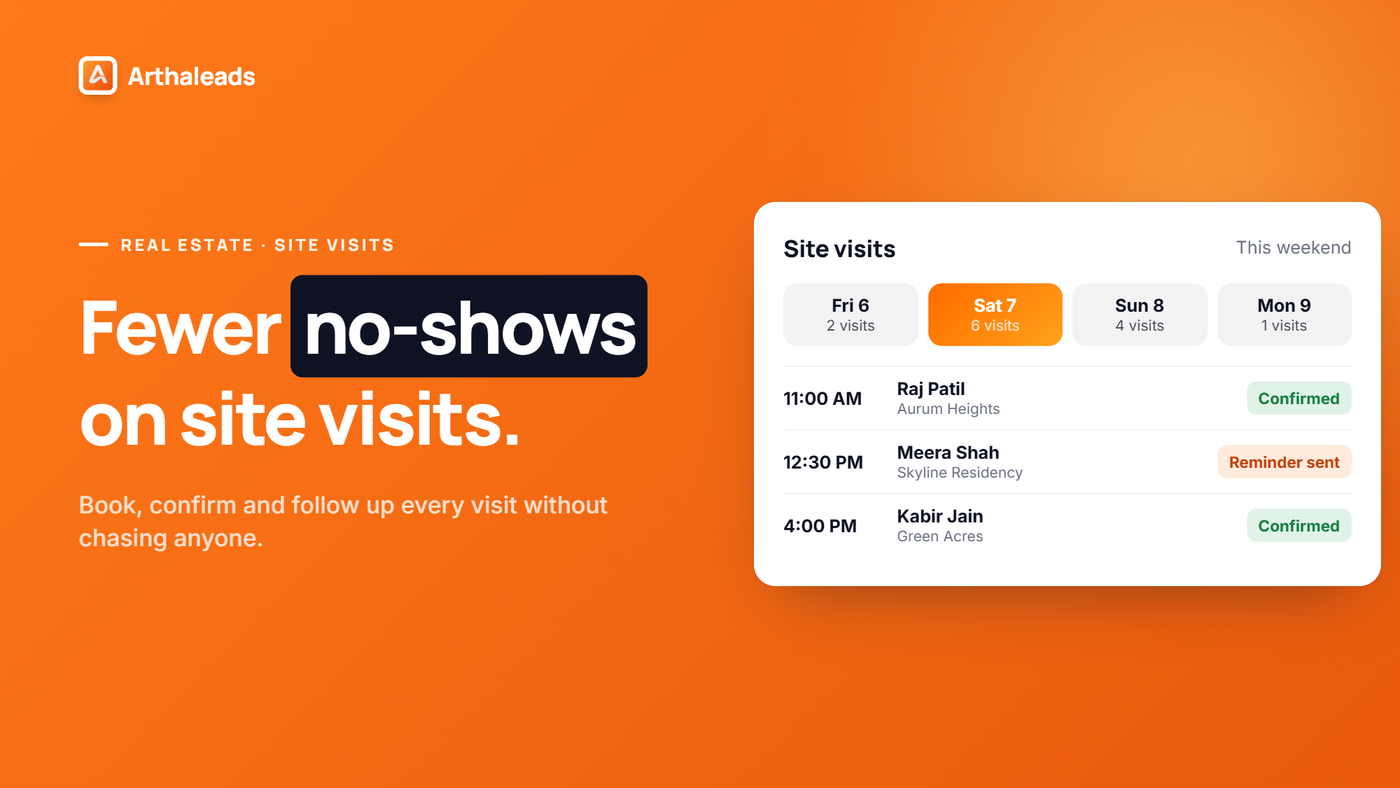
In Indian real estate, the site visit is where most bookings are really decided. A buyer can like a brochure and a price sheet, but few people commit lakhs or crores without standing in the flat, checking the view and driving the approach road. Yet many teams treat visits casually: a time agreed on a call, no reminder, no record of what happened, and a follow-up that arrives three days later, if at all. This guide sets out a practical process for booking, confirming and following up every visit, so fewer buyers drop out between "yes, I'll come on Sunday" and the booking form.
Qualify before you book a site visit
Every site visit costs your team real time: a sales manager on the floor, sometimes a pickup car, and a weekend slot that another buyer could have used. It is worth a few questions on the first call to make sure the visit is likely to be useful for both sides.
Before booking, try to know:
- Configuration and budget: does what they want (2 BHK, 3 BHK, a plot) exist in this project within their range?
- Timeline: are they buying in the next few months, or just starting to look?
- Decision makers: who else needs to see the flat? Spouse, parents, a co-applicant?
- Funding: self-funded, home loan, or depending on selling another property?
- Purpose: self-use or investment, which changes what you show them.
This is not about turning people away. A buyer who is early in their search still deserves a visit, but you might book them on a quieter weekday rather than a peak Sunday slot. For a fuller view of the path from enquiry to visit, see our guide on real estate lead management from first enquiry to site visit.
Book the slot properly
A vague "come this weekend" is not a booking. A booked visit has five things written down on the lead:
- Date and time, agreed with the buyer.
- The project and, where relevant, the tower or sample flat to be shown.
- Who is coming, including the family members who will decide.
- Who from your team will host them.
- Whether they need a pickup or directions.
Spread visits through the day so each family gets attention. Two families arriving at the same sample flat at the same time usually means neither gets a proper walkthrough. If the buyer came through a channel partner, note the partner on the lead before the visit happens, so there is no confusion about credit later.
Move the lead to a "Site Visit" stage in your pipeline the moment it is booked. That way the manager can see the week's visits at a glance and spot anyone without a host.
Site visit confirmations and reminders on WhatsApp
Most site visit no-shows are not rejections. People forget, plans change, or the buyer was never quite sure of the time. A short sequence of messages fixes much of this.
- Right after booking: a confirmation with the date, time, project name, host's name and a map link. Google Maps lets you copy a link to a location or directions and share it, which saves the buyer a call asking for the way.
- The evening before: a friendly reminder, asking them to reply to confirm or to reschedule.
- Two hours before: a short note with the host's number, and parking or gate instructions if the site is hard to find.
If the buyer has not messaged you recently, WhatsApp only allows approved message templates. Meta's documentation on message templates explains that templates are the only type of message that can be sent outside an open customer service window, so it is worth getting a reminder template approved before you need it.
When a buyer cancels, reply warmly and offer two new slots right away. A cancellation with a new date is still a live buyer; a cancellation with no reply is a lost one.
Tools can take some of this work off the team. ArthaLeads, for example, has an AI agent on WhatsApp that can answer questions, share the brochure and location, and book visits, with the team able to take over any chat. Read more on the WhatsApp CRM page.
The day-of checklist
On the day, a few small things make a large difference to how the buyer feels about the project.
- Check the list of today's visits first thing in the morning and confirm each host.
- Make sure the sample flat is clean, lit and unlocked, and that lifts and approach roads are usable.
- Keep printed price sheets, floor plans and payment plans ready for each configuration the buyers asked about.
- Have the host read the lead's notes before the family arrives: budget, configuration, concerns raised on the call.
- Greet them by name. Nothing tells a buyer they matter more than being expected.
- Walk them through the flat first, then the amenities, then sit down for numbers. Price talk before they have seen anything rarely goes well.
Record the site visit outcome the same day
The most common gap in the whole process is here. The family leaves, the host moves to the next visit, and by evening nobody remembers what the buyer said about the east-facing unit.
Before the end of the day, the host should record:
- Whether the visit happened, was rescheduled, or was a no-show.
- Who came and who seemed to be the decision maker.
- What they liked and what worried them, in their words.
- The units or configurations they shortlisted.
- Their likely next step: a second visit, a family discussion, a loan check, or ready to book.
- The next follow-up date and time.
Notes like "positive, will revert" help no one. A note like "liked 3 BHK on 9th floor, worried about possession date, father to visit on Saturday" gives the next call a clear purpose.
Follow up within 24 hours
The day after the site visit is when buyers compare. They have seen your project and, often, two others the same weekend. A follow-up within 24 hours, while your sample flat is still fresh in their mind, keeps you in the conversation.
A good first follow-up:
- Thanks them for coming, by name.
- Sends the floor plan and cost sheet for the exact unit they liked.
- Answers the concern they raised, or says when you will have the answer.
- Proposes the next step with a date: a second visit for the parents, a call with the loan team, or a time to discuss the payment plan.
After that, follow the cadence you use for any warm lead. Our guide to a real estate follow-up system that works covers spacing, what to say on the third and fourth calls, and when to mark a lead as lost.
Measure site visit to booking
What you measure decides what the team works on. Counting enquiries alone rewards volume; counting visits and what came after them rewards quality.
A few numbers, checked every week, are enough:
- Visits booked and visits done, so you can see the no-show rate.
- Visit-to-booking rate, overall, by project and by source.
- Follow-ups done within 24 hours of a visit, out of all visits.
- Revisits, because a buyer who comes back with family is usually close.
Look at these by host as well as by source, but use them to coach rather than to punish. A host with many visits and few bookings may need help with objections; a source with many enquiries and few visits may need a different message. For a fair way to look at team numbers, see how to measure a real estate sales team without micromanaging.
Virtual site visits for NRI and out-of-town buyers
Not every buyer can come to the site. NRI buyers and families moving from another city often shortlist from a distance, and a well-run video walkthrough can do much of the work of a first visit. Treat it with the same care as a visit in person:
- Book it like any other visit: a date, a time in the buyer’s own time zone, a host and the Site Visit stage in your pipeline.
- Use a video call the buyer already has, such as WhatsApp or Google Meet, and test the network at the sample flat beforehand.
- Show the view from the balcony, the approach road and the amenities, not only the rooms. These are what a buyer cannot judge from a brochure.
- Send the floor plan and cost sheet before the call, so the buyer can follow along and ask about the exact unit.
- Record the outcome the same day, exactly as for a visit in person, and offer a physical visit to any family member who lives in the city.
Putting it together
Every step in this process is simple. The hard part is doing it for every buyer, every week, without relying on memory. A CRM helps by keeping the booking, reminders, notes and follow-up dates on one lead record that the whole team can see. ArthaLeads brings these together with follow-up reminders, a pipeline with a visit stage, and conversion and booking analytics; you can see the full list of features.
If you would like to try it on your own visits, start a 14-day free trial and book your next weekend's visits through it.
Frequently asked questions
How many site visits does it take to close a real estate booking?
There is no fixed number. Many buyers book after one or two visits, and a second visit with parents or a spouse is common before the final decision. Track revisits separately in your CRM: a buyer who comes back with family is usually close to booking.
How do you reduce site visit no-shows?
Confirm the visit on WhatsApp right after booking, remind the buyer the evening before, and send the host's number and directions about two hours before. Most no-shows come from forgetting or changed plans, so a reminder and an easy way to reschedule recover many of them.
What should you record after a site visit?
Record whether the visit happened, who came, what the family liked and what worried them, the units they shortlisted, and the next step with a date. Do it the same day, before the details fade, so anyone on the team can pick up the follow-up.
When should you follow up after a site visit?
Within 24 hours. Buyers compare projects the day after their visits, so thank them by name, send the cost sheet for the unit they liked, answer the concern they raised and propose a next step with a date.
Can you send site visit reminders on WhatsApp to buyers who have not messaged recently?
Yes, but only with a message template approved by Meta, because free-form WhatsApp messages are allowed only within 24 hours of the buyer's last message. A utility template for visit confirmations and reminders covers most cases.
About Arthaleads
Arthaleads is a CRM for Indian real estate sales teams. It brings enquiries from ads, portals, your website and WhatsApp into one workspace, with follow-ups, projects, bookings and invoices. These articles are educational and are not a substitute for advice based on your own business and data.