

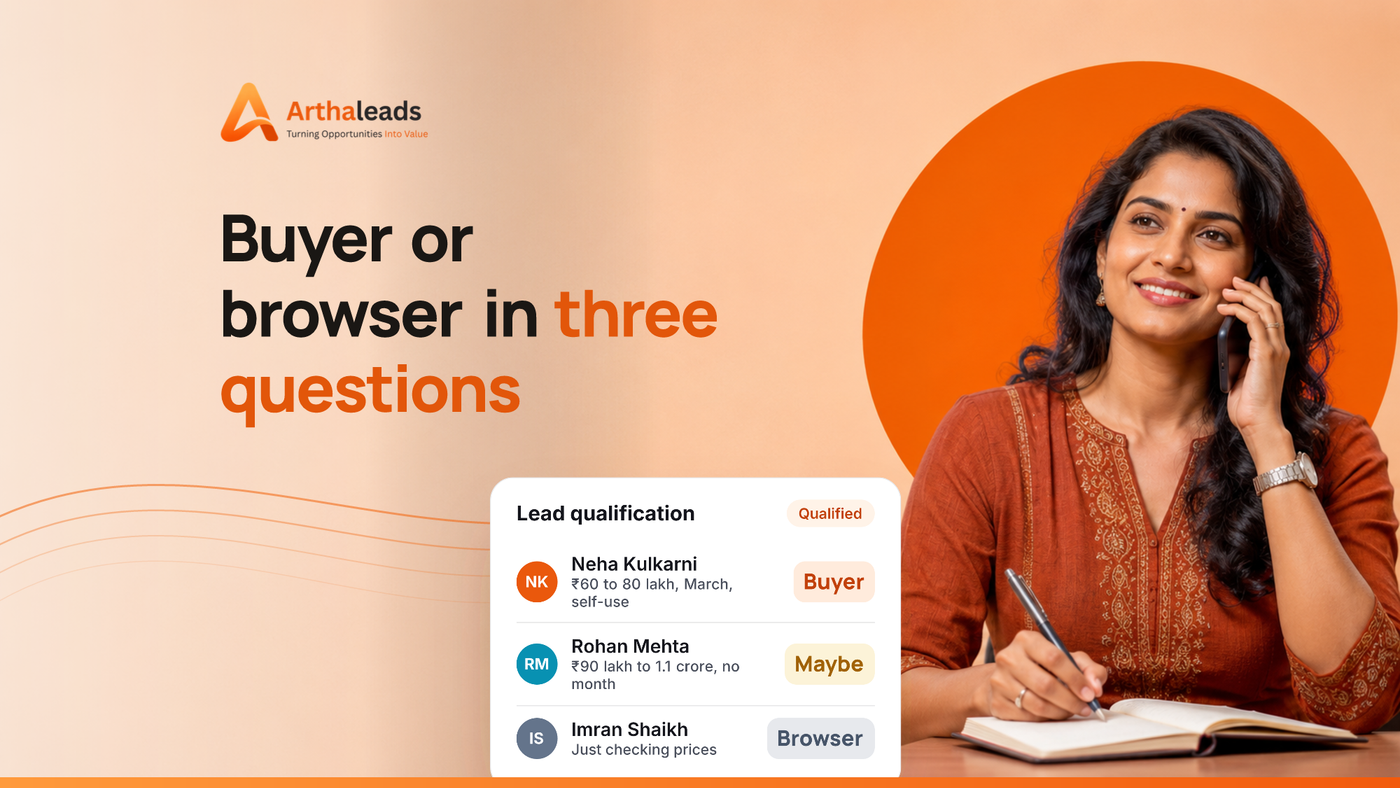
A portal lead comes in, a telecaller calls, the buyer says 'send details', and two weeks later nobody knows whether that person was ever serious. How to qualify real estate leads comes down to three questions in the first conversation, and a clear action for each answer. Without them, your best site visit slots go to browsers.
The three are budget, timeline and purpose. Below you get the wording in English and Hinglish, what each answer tells you, and what the rep does next: book the visit, nurture with a date, re-route or close politely.
It also covers the calling and consent rules that apply while you ask, five CRM fields to fill before a visit, and three numbers to track from your own data.
What is a qualified real estate lead?
A qualified real estate lead is an enquiry where the rep knows three things: a budget range that fits something you sell, a purchase timeline given as a month, and the reason for buying. It is not simply someone who picked up the phone or asked for a brochure. Qualified means the lead deserves a site visit slot and a senior rep's time.
Beegru, in its guide to pre-qualified leads, defines a pre-qualified Indian lead as one with a confirmed budget range, a specific requirement (location, type, size) and a purchase timeline within 3 to 12 months. Your own definition can be tighter or looser, but it must be written down.
Give the whole team one line, for example: Qualified means a budget range within our price band, a purchase month within 12 months, and a stated purpose, all recorded in the CRM.
A lead who refuses to share a budget is not disqualified. That lead is 'not yet known', and you ask again after sending a price sheet.
How to qualify real estate leads in 3 questions
To qualify a property lead, ask three questions in the first conversation: what budget range is comfortable, which month the buyer plans to decide, and whether the purchase is for self-use, investment or just looking. Ask them in that order, in the buyer's own language, and record each answer before you pitch a unit.
Budget, as a range
English: 'Which range suits you, ₹60 to 80 lakh or ₹80 lakh to 1 crore?' Hinglish: 'Budget kitna soch rahe hain, 60 se 80 lakh ya 80 lakh se 1 crore?'
Timeline, as a month
English: 'When are you planning to decide: this month, this quarter or later?' Hinglish: 'Lena kab tak hai, is mahine, is quarter ya baad mein?'
Purpose, as a reason
English: 'Is this for your family to live in, or an investment?' Hinglish: 'Ghar mein rehne ke liye hai ya investment ke liye?'
Ask in a normal conversation, not as a form: mention the project they enquired about, share one useful fact, then ask. If the buyer does not recognise the enquiry at all, stop and log it instead of qualifying.
What do the budget, timeline and purpose answers tell you?
Each answer tells you something different. Budget decides which units you show, timeline decides how soon a site visit is worth booking, and purpose decides what you talk about once the buyer is there. Read the three as a set, because a big budget with no timeline is a nurture lead, not a hot one.
Budget: ask for a range, not a number
Buyers hesitate to quote an exact figure to a stranger, but a range is easy to answer and still lets you place them. Say your 2 BHK units run from ₹78 lakh to ₹92 lakh. A buyer who says ₹60 to 80 lakh overlaps only at the bottom, while a buyer who says ₹90 lakh to 1.1 crore fits comfortably.
- Range inside your price band: move on to timeline.
- Range overlaps only at the edge: confirm they know your starting price and offer one or two fitting units.
- Range far below your units: re-route to a better-fit project or partner inventory, or close politely, and log the reason.
- No range given: log 'budget not shared' and ask again next time. Do not mark the lead disqualified.
Timeline: ask for a month, not 'soon'
'Soon' can mean next week or next year. A month cannot, so offer choices (this month, this quarter, later) and let the buyer commit to one.
- Within about 3 months: a visit is worth booking this week.
- 3 to 12 months: a real buyer who is early. Create a nurture task dated just before the month they gave.
- No month, or 'just checking prices': treat as a browser until a later chat says otherwise.
Purpose: self-use, investment or just looking
Purpose changes the pitch, not just the label. A family buying to live in will ask about possession date, floor and the daily commute, while an investor will ask about location and payment plan. If someone is 'just looking', ask what made them start searching now, and note the answer in their own words for the follow-up call.
What should a rep do after each answer?
Read the three answers together and place the lead as a buyer, a maybe, a budget mismatch or a browser. A buyer gets a booked site visit, a maybe gets a dated nurture task, a mismatch is re-routed, and a browser is closed politely with the door open. No lead is left without a next action and a date.
| Group | Budget | Timeline | Purpose | Next action |
|---|---|---|---|---|
| Buyer | Fits your price band | Within about 3 months | Clear | Offer two visit slots, assign a senior rep |
| Maybe | Fits, or not shared yet | 3 to 12 months, or unclear | Stated but thin | Send matching options, set a dated nurture task |
| Mismatch | Far from your units | Any | Any | Re-route to a better-fit project, log the reason |
| Browser | Not shared | No month | Just looking | Send a price sheet, close politely, ask before sending updates |
When the answers disagree
- High budget, no timeline: a maybe. Send one relevant project note and ask what would make them decide.
- Clear timeline, low budget: a mismatch. Try fitting units or partner inventory before you let go.
- Clear budget and timeline, investment purpose: a buyer. Plan the visit around payment plan and location.
- Prices only, no month, no reason: a browser. Do not spend a visit slot.
The decision rule is simple: a 'no' is never left as a bare 'not interested'. It becomes either a closed lead with a reason, or a nurture task with a date. To rank leads inside each group, the 100-point sheet in real estate lead scoring works alongside these three questions.
Should you qualify on a call or on WhatsApp?
Qualify on the channel the buyer used. If they filled a portal form or called you, ring them. If they messaged on WhatsApp, ask the three questions there, one per message. Either way, the rules on calling consent, WhatsApp opt-in and data purpose apply while you collect budget and purpose.
A call is quicker and lets you hear hesitation. WhatsApp suits a buyer who does not pick up and leaves a written record of what was said.
The 7-day calling rule
According to a PIB release of 12 February 2025, the TCCCPR amendment makes customer consent to complete an ongoing transaction valid for only 7 days, and after an opt-out consent cannot be requested again for 90 days (as of November 2026). Finish qualifying and book the visit inside that window. The detail is in TRAI rules for real estate calls.
Data purpose and WhatsApp opt-in
A PIB note on the DPDP Rules 2025 says the rules were notified on 14 November 2025 with an 18-month phased compliance period. It adds that the notice must state the specific purpose of collection, consent can be withdrawn at any time, and the principles include purpose limitation and data minimisation. Our DPDP Act checklist for real estate leads covers the steps.
WhatsApp's developer documentation on opt-in says a business must get opt-in before messaging people and must name the business the person is opting in to.
- Confirm the buyer recognises the enquiry before asking anything.
- Say why you ask: to match the right units.
- Ask only budget, timeline and purpose first. Leave income and documents for later.
- Log any 'stop calling' request straight away.
How do you record qualification in the CRM?
Record every answer in the CRM before a site visit is booked, using five fields: budget range, purchase month, purpose, status, and a reason with a next date. Free-text notes get lost, while fields let a manager filter, assign and chase. If a field is empty, the lead is not yet qualified.
| Field | What to enter | Example |
|---|---|---|
| Budget range | The band given, or 'not shared' | ₹60 to 80 lakh |
| Purchase month | A month, not 'soon' | March 2027 |
| Purpose | Self-use, investment or just looking | Self-use |
| Status | Buyer, maybe, mismatch or browser | Maybe |
| Reason and next date | One line why, plus follow-up date | Possession after school year, call 10 Jan |
You can also ask before a rep calls. According to Meta Business Help, the Higher Intent form type adds a review step so people can confirm their details, and you can add up to 15 custom questions (as checked in November 2026). Nine Degree, an Indian agency, argues that budget and timeline questions carry more intent than name and phone alone but raise cost per lead. That is an agency view, not Meta data, so test two or three questions and compare.
Then the rep confirms instead of interrogates: 'You mentioned ₹60 to 80 lakh, is that still right?' Whatever tool you use, it should turn the nurture date into a reminder. Arthaleads, for example, brings enquiries from Facebook and Instagram lead ads, WhatsApp and website forms into one place, assigns each lead to a person and reminds them to follow up. See real estate lead management software for how that works.
What are the common qualification mistakes?
The common mistakes are interrogating the buyer, over-filtering on a missing answer, and not recording what was said. Each costs you a buyer or a clean pipeline. Qualification should feel like a helpful conversation where the rep gives information as well as taking it.
- Interrogating: five questions in a row on the first call. Ask one, give one useful fact, then ask the next.
- Over-filtering: treating 'budget not shared' as disqualified. Log it and ask again after a price sheet.
- Counting connected calls as qualified: a pick-up is not an answer to any of the three questions.
- Asking for exact figures: this invites a refusal. Offer ranges.
- Not recording: when the lead is reassigned, the new rep asks everything again and the buyer notices.
How do you check your team is qualifying well?
Track three ratios from your own data: how many leads carry all five fields, how many booked visits actually happen, and how many attended visits turn into bookings. Compare them month to month and rep to rep. Do not copy a benchmark from a blog.
According to Sthan's note on site-visit conversion benchmarks, credible India-specific site-visit-to-booking percentages barely exist in public and most trace back to vendor marketing. It suggests tracking leads to visits booked, booked to attended, and attended to bookings, with your own definitions, and says qualifying before the visit helps who turns up.
| Stage | Example count | What to check |
|---|---|---|
| Leads logged | 300 | Share with all five fields filled |
| Marked buyer | 120 | Are reps labelling loosely? |
| Visits booked | 70 | Booked as a share of buyers |
| Visits attended | 50 | The no-show gap between booked and attended |
| Bookings | 6 | Bookings as a share of attended visits |
The counts are sample figures, not a benchmark: in this example 50 of 70 booked visits happened and 6 of 50 attended visits became bookings. If your no-shows are high, tighten the qualifying and the visit confirmation.
Arthaleads is real estate CRM software for builders, developers, channel partners and brokers in India. It tracks each lead from first call to site visit and booking, adds AI lead scoring with reasons, and offers a 14-day free trial of Growth with no credit card.
Frequently asked questions
How do you qualify a real estate lead?
Ask three questions in the first conversation: budget as a range, purchase timeline as a month, and purpose as self-use, investment or just looking. Record each answer in the CRM. Then book a visit, set a dated nurture task, re-route or close politely based on the combination.
How do you ask a buyer's budget without sounding pushy?
Offer two ranges instead of asking for a figure, such as '60 to 80 lakh or 80 lakh to 1 crore?'. Explain that you are matching units to what they can comfortably consider. If they decline, log 'budget not shared' and ask again after sending a price sheet.
What should I do with leads who say they will buy in 6 to 12 months?
Treat them as real but early. Record the month they gave, send relevant updates, and create a follow-up task dated shortly before that month. Do not spend visit slots on them yet unless they ask.
How do I know if a lead is a serious buyer or just a browser?
A serious buyer gives a budget range that fits your units, a month for the decision, and a reason for buying. A browser stays vague on all three and asks only for prices. Mixed answers make a 'maybe', not a browser.
Should I qualify on WhatsApp or on a call?
Use the channel the buyer used first. Call portal enquirers and callers, and ask on WhatsApp if they messaged you, one question at a time. Follow the calling and consent rules on either channel.
About Arthaleads
Arthaleads is a CRM for Indian real estate sales teams. It brings enquiries from ads, portals, your website and WhatsApp into one workspace, with follow-ups, projects, bookings and invoices. These articles are educational and are not a substitute for advice based on your own business and data.